I was lucky enough to get tickets to the Black Sabbath ‘Back to the Beginning’ farewell concert last summer. It was a who’s who of heavy rock and metal sub-genres celebrating the legacy and final musical outing of frontman Ozzy Osbourne, who died from Parkinsons disease just a few weeks later.
On that sunny day in July, surrounded by thousands of heavy music fans, I saw more battle jackets in a single place than ever before. Among them was the one worn by my partner. He suggested that I should make one for myself.
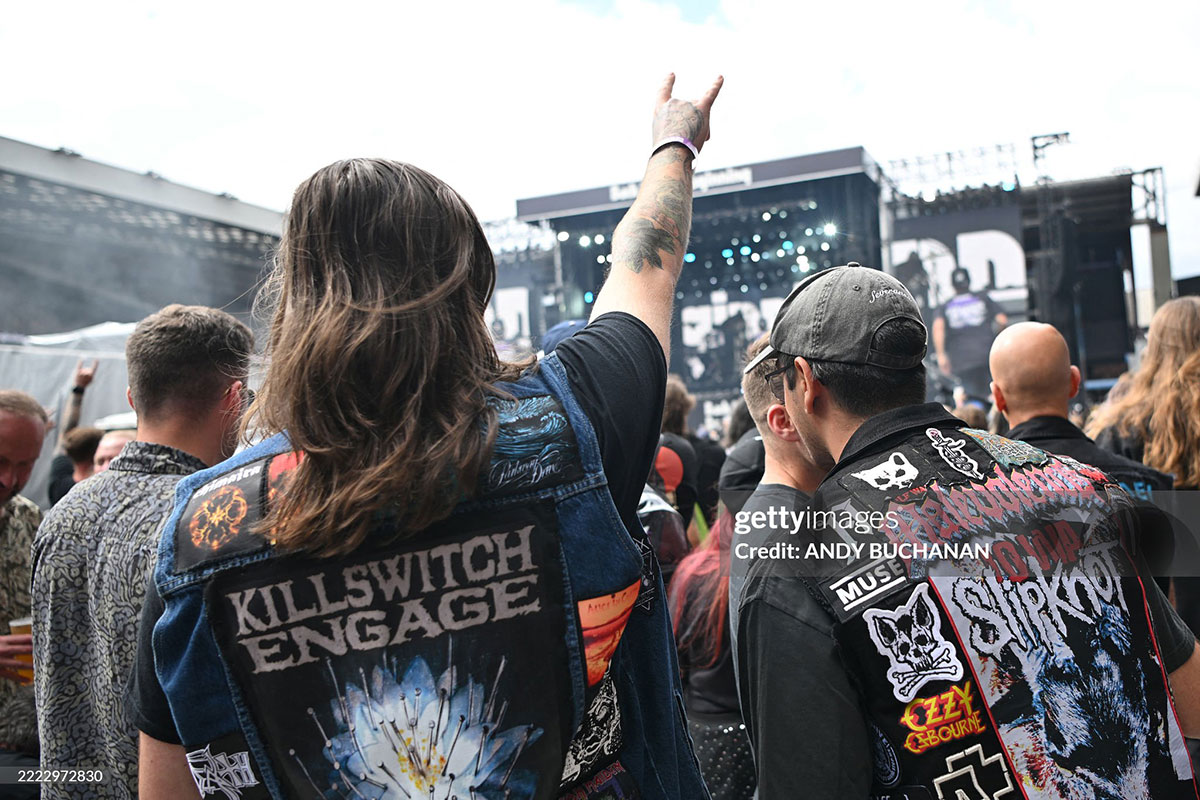
The crowd at Black Sabbath’s ‘Back to the Beginning’ concert, including two men in the foreground wearing battle jackets. Thomas Cardwell describes battle jackets – variously known as battle vests, patch jackets, or cut-offs – as a denim jacket, usually with the sleeves removed, decorated with patches, badges, studs, handmade artwork, and other embellishments, created by the owner to display their musical taste and allegiances. Photo by Andy Buchanan/AFP via Getty Images.
However, despite having worked as a music journalist for publications in Australia and the UK, organised gigs, and managed several friends’ bands over the years, I don’t think I feel passionately enough about enough bands (or certainly not enough of the same genre) to fill a cut-off denim jacket with embroidered patches.
But as I waited in the bar queue, or maybe the toilet queue (no, it must have been the bar queue, because the Black Sabbath farewell show was one of those rare gigs where there was barely any queue for the women’s toilet!), I had an idea.
Maybe I could create a women’s history battle jacket.
The more I thought about it, the more excited I became by the idea, because – and bear with me here – there are actually some significant commonalities between the development of heavy metal and its community of fans, and the development of the field of women’s history and the community of people who practise it.
Let me elaborate.
Origin story
The academic field of women’s history was born under the influence of the second wave feminist movement of the 1960s. It coincided with a broadening interest in social history, which focuses on the lives of ordinary people – such as the working class – rather than the traditional ‘great man history’ largely focused on titled elites and political and military leaders.
Around the same time, four young working-class men were turning to music as an escape from factory life in Birmingham, in the West Midlands of England. Their band would soon be known as Black Sabbath, and they are credited with creating heavy metal.
Both the history field and the style of music came to be in the same era, amid (or at least, alongside study of) the same social milieu.
The importance of community amid marginalisation
As I’ve written previously, it took a social movement, a community of women, to carry the idea and the practise of women’s history forward. But decades on from the field’s establishment, women remain under-represented in the teaching and production of history.
Similarly, while Black Sabbath invented a new style of music, it was the fans that created the genre. Battle jackets are a marker of their membership of the “metalhead” community, a group “set apart from the mainstream”. Their clothing expresses solidarity and allegiance, not only to an alternative form of music, but an alternative way of life.
The participant community was critical to the establishment of both the history field and the music genre, and heavy metal fans are seen as outsiders (albeit self-styled), just as women’s history remains marginalised.

There’s an unwritten rule that a battle jacket should focus on a single musical genre, or even a single band. But equally, members of the metalhead community don’t have a problem breaking rules. Cardwell interviewed a long-time metal fan called Pete who described his battle jacket as “documenting my life and my taste in music, and consequently there’s a lot of non-metal stuff on here as well, which really fucks people off! […] all your ‘true metal heads’ go ‘How can you have that next to that?!’ And I say ‘Because I like ‘em. Got a problem?!’.” My partner – whose jacket is pictured here – subscribes to the ‘no rules’ philosophy.
Subverting gender stereotypes
A sign of authenticity of a battle jacket and its maker is that the patches are hand sewn. Some jackets even feature hand embroidery. Cardwell has pointed out the contrast here: that the masculine-coded world of heavy metal employs the feminine-coded skill of needlework as part of its identity fashioning.
It’s that same up-ending of gender expectations that I’m going for in my creation: using textile art to celebrate the rich field of women’s history and make the point that women’s contributions to the past go far beyond just their sewing and spinning skills and are worthy of deeper exploration.
(There’s an infuriating story relating to Bathsua Makin, a great woman scholar of the 17th Century, who, at the age of 16, presented a collection of her writings, in six different languages, to King James I. It was recorded that James responded: “but can shee spin?”. Sigh. Of course, if women did/do choose to pursue the textile arts, those skills should be celebrated, and not considered “just what ladies do […] for their own amusement”.)
A women’s history battle jacket
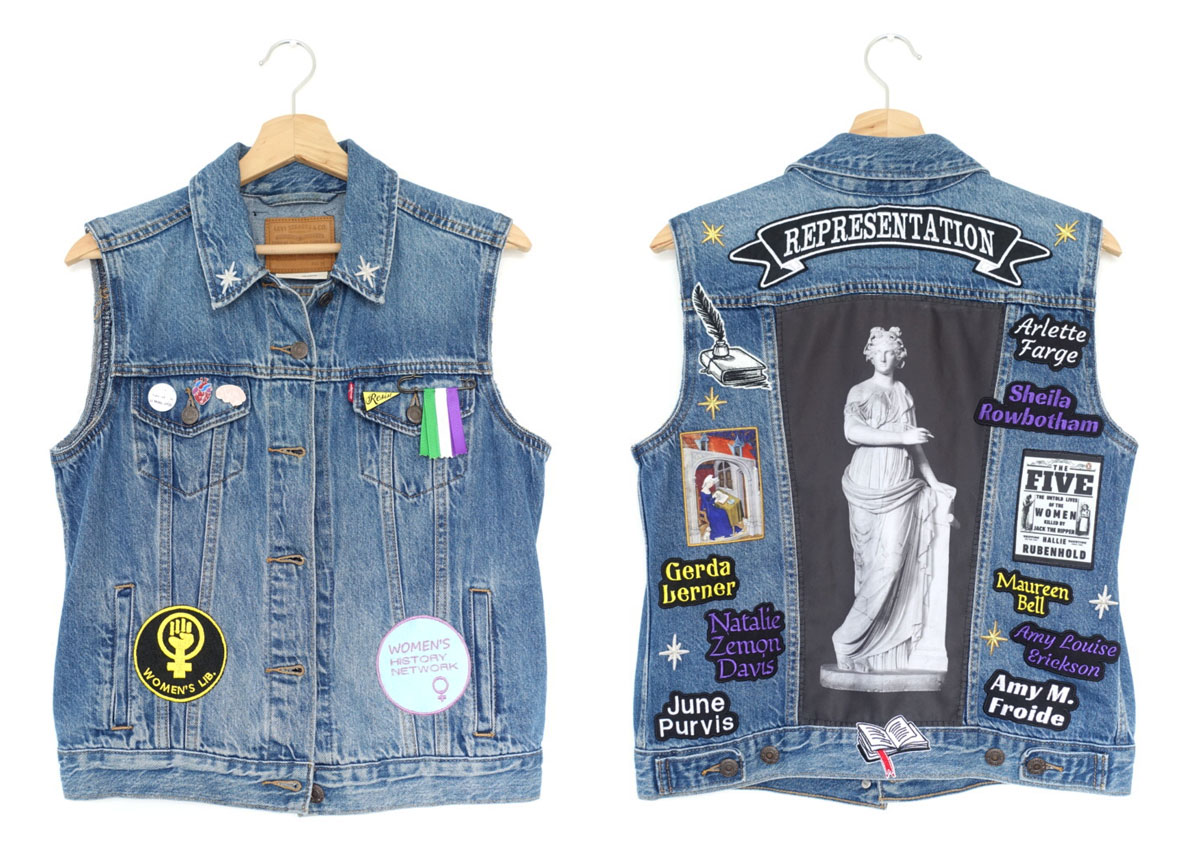
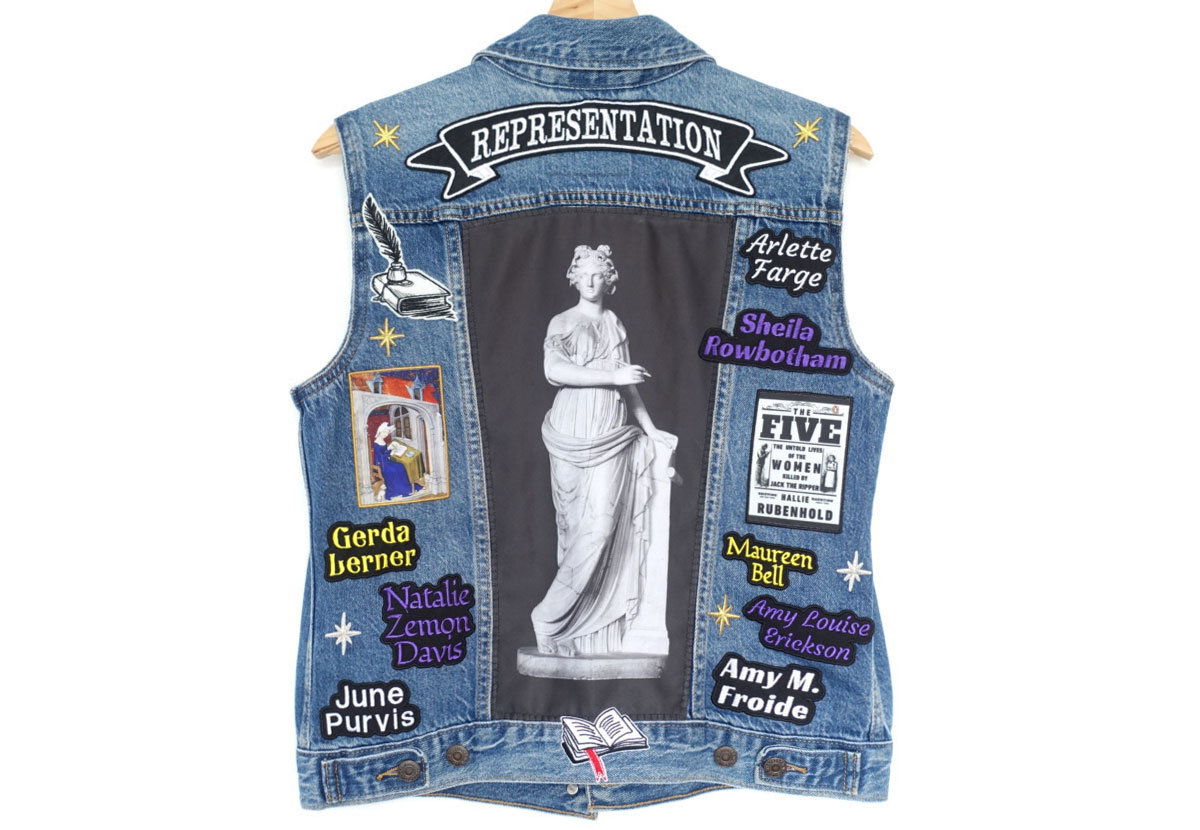
My battle-for-women’s-representation-in-history jacket.
Battle jackets are meant to be added to. They’re an article of living cultural heritage that reflect the maker’s musical influences and inspirations; chart the artists, albums, gigs, and festivals that have had an impact on that person’s life.
My battle-for-women’s-representation-in-history jacket is still a work in progress. Its focus is on the women who have done the work – fought the battle – to uncover women’s presence and contributions in the past, to recover the women previously ‘hidden from history’. I’ve dedicated the back of my jacket to my own (still early career) experience as a historian, spotlighting those whose research I’ve most frequently cited and/or been inspired by. The front celebrates the community aspect of the field, and I invite my fellow women’s history community members to help me add to it; to tell me: who and/or what am I missing?
Who’s who
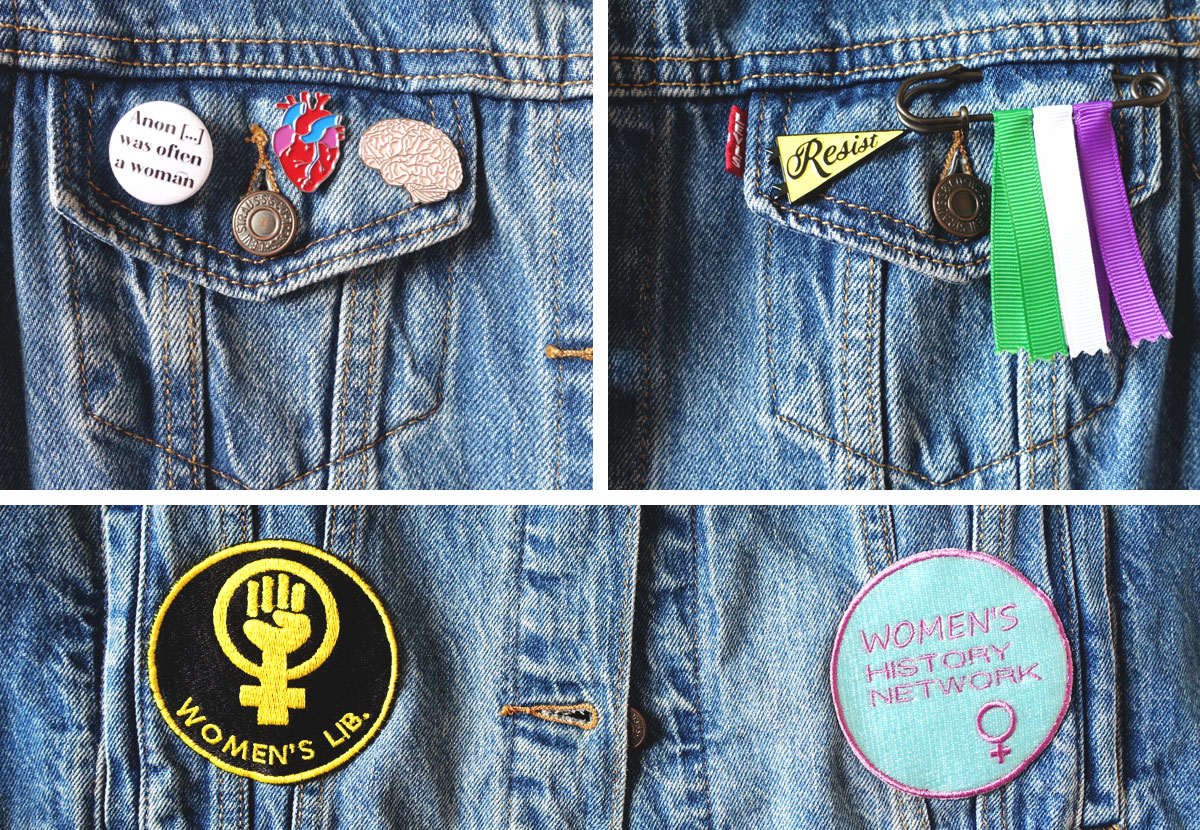
Front:
- Anon […] was often a woman’ Virginia Woolf quote button: for the women writers obscured from the historic record by the barriers of social and cultural convention.
- Head and heart pins: because for many women (myself included) doing women’s history is an intellectual as well as an emotional practice.
- Women’s Lib patch: replica of a 1970s patch – it was amid this movement that the academic field of women’s history was born.
- Resist ‘the marginalisation of women in history’ pin.
- Suffrage movement ribbons: because the first wave feminist movement of the late 19th and early 20th centuries (of which women’s suffrage was a large focus) did inspire a series of women’s history works, however visibility and momentum was lost when the movement fragmented after the First World War.
- Women’s History Network patch: one of the many communities (this one UK based) that celebrates, supports, and furthers our practice today.
Back:
- Clio (central image): the ancient Greek muse of history.
- Christin De Pizan (image): one of the earliest professional writers in Europe and author of one of the earliest histories of women, the 15th Century ‘The Book of the City of Ladies’.
- Gerda Lerner: established the first post-graduate degree in women’s history in the United States at Sarah Lawrence College and was influential in pushing for a new approach to doing women’s history. She urged practitioners to go beyond ‘women worthies’ or ‘compensatory history’ (which focuses only on notable women, not the vast majority of ordinary women), beyond ‘contribution history’ (which examines women’s roles and achievements in relation to men/within male-defined society), to go beyond all existing methodologies and conceptual frameworks (none of which could “fit the complexities of the historical experience of all women”) and “explore the possibility that what we call women’s history may actually be the study of a separate women’s culture”; a culture of experiences, consciousness, and the tensions between “prescribed patriarchal assumptions and women’s efforts to attain autonomy and emancipation”.
- Natalie Zemon Davis: taught one of the first courses in North America on the history of women and gender at Toronto University, and was also a pioneer in microhistory, which is particularly well suited to exploring the ordinary and the marginalised, such as the lives of women. I took inspiration from her work (particularly ‘The Return of Martin Guerre’ and ‘Women on the Margins’) in writing my own microhistory of 17th Century Essex proprietress Elizabeth Goever.
- June Purvis: Founding and Managing Editor of the ‘Women’s History Review’ journal. I have a particular soft spot for Purvis for her article about debate and controversy in women’s history in Britain, in which she set out a seven-point opposition to gender history as an alternative to women’s history. It included concerns about turning women into “social constructs”, de-radicalising women’s history to make it “less threatening to the male establishment”, and that gender history implicitly denied the existence of patriarchy and the existence of women as a political and subordinate class. She concluded that it was critical that women were kept centre stage to avoid “our past being pushed back into obscurity, yet again, and of being marginalized and distorted through a male lens”.
- Arlette Farge: celebrated for her ability to read sources ‘against the grain’ and use judicial and legal records to recover the voices of ordinary people, including women. She also (like me) loves an archive!
- Sheila Rowbotham: her 1973 book ‘Hidden from History: 300 Years of Women’s Oppression and the Fight Against It’ was one of the first works of women’s history published in the UK around the time the field was formalised, and was similarly inspired by Rowbotham’s involvement in the second wave feminist movement.
- ‘The Five’ by Hallie Rubenhold (cover image): the book that opened my eyes to the potential of historical non-fiction and inspired me to professionalise my own interest in history by doing a master’s degree.
- Maureen Bell: created ‘A Dictionary of Women in the London Book Trade, 1540-1730’ for her dissertation and kindly shared it with me for an essay I was writing on the subject. The ‘Dictionary’ (and other articles Bell has written about individual women) proved that, despite gendered assumptions to the contrary, it was common for women to be involved, on a day-to-day basis, at different levels within the Stationers’ Company and its associated trades, “buying and assigning copies; taking, transferring and freeing apprentices; pirating other people’s copies; being prosecuted, fined and imprisoned by the authorities; entering into partnerships and congers; and controlling stock, workers and businesses for years at a time”.
- Amy Louise Erickson: her book ‘Women & Property in Early Modern England’ has been an invaluable resource to help me understand this period, including in my study of women’s wills.
- Amy M. Froide: I’ve cited her work on single women in multiple of my own essays and stories, including her analysis of data from various 17th Century English communities which revealed that at least one third of adult women were single, and the majority of these (3:2 in Southampton, for example) were unmarried rather than widowed – challenging assumptions that all single women in this period were ‘wives in waiting’.

Sources:
- Kate Andrews, ‘Back to Black: celebrating heavy metal heritage’, The National Lottery Heritage Fund (2016).
- Maureen Bell, ‘A Dictionary of Women in the London Book Trade, 1540-1730’ (1983).
- Thomas Cardwell, ‘Battle Jackets: Wearing Metal Identity’, The Cambridge Companion to Metal Music (2023).
- Amy M. Froide, ‘Hidden Women: Rediscovering the Singlewomen of Early Modern England’, Local Population Studies (2002).
-
‘History’, BlackSabbath.com.
- Gerda Lerner, The Creation of Feminist Consciousness: From the Middle Ages to Eighteen-Seventy (1993); ‘Placing Women in History: Definitions and Challenges’, Feminist Studies, 3.1/2 (1975).
- Fiona Montgomery and Christine Collette, The European Women’s History Reader (2002).
- Lauren Alex O’Hagan, ‘“My Musical Armour”: Exploring Metalhead Identity through the Battle Jacket’, Rock Music Studies, vol. 9, no. 1 (2022).
- Carol Pal, ‘Bathsua Makin: female scholars and the reformation of learning’, Republic of Women: Rethinking the Republic of Letters in the Seventeenth Century (2012).
- June Purvis, ‘From “Women Worthies” to Poststructuralism? Debate and Controversy in Women’s History in Britain’, Women’s History: Britain, 1850-1945: An Introduction (1995).