It’s often been said that among the earliest examples of a women’s history output was ‘The Book of the City of Ladies’ by Christine De Pizan, created in the early 15th Century. Gerda Lerner is among those who’ve cited this, and agreed with it as a broad generalisation.
But she’s also found evidence, from at least the 7th Century, of women’s “significant and almost constant effort” to create women’s histories. The problem she found, however, was that due to social and cultural conditions of the times, rather than these women’s work building successively on each other, they “developed in a repetitive, circular pattern, with generation after generation of women repeating what others had done before them”.
Lerner said that “Women’s History couldn’t be created as an intellectual pursuit in the absence of a social movement of women”; that it required communities of women to carry the ideas forward.
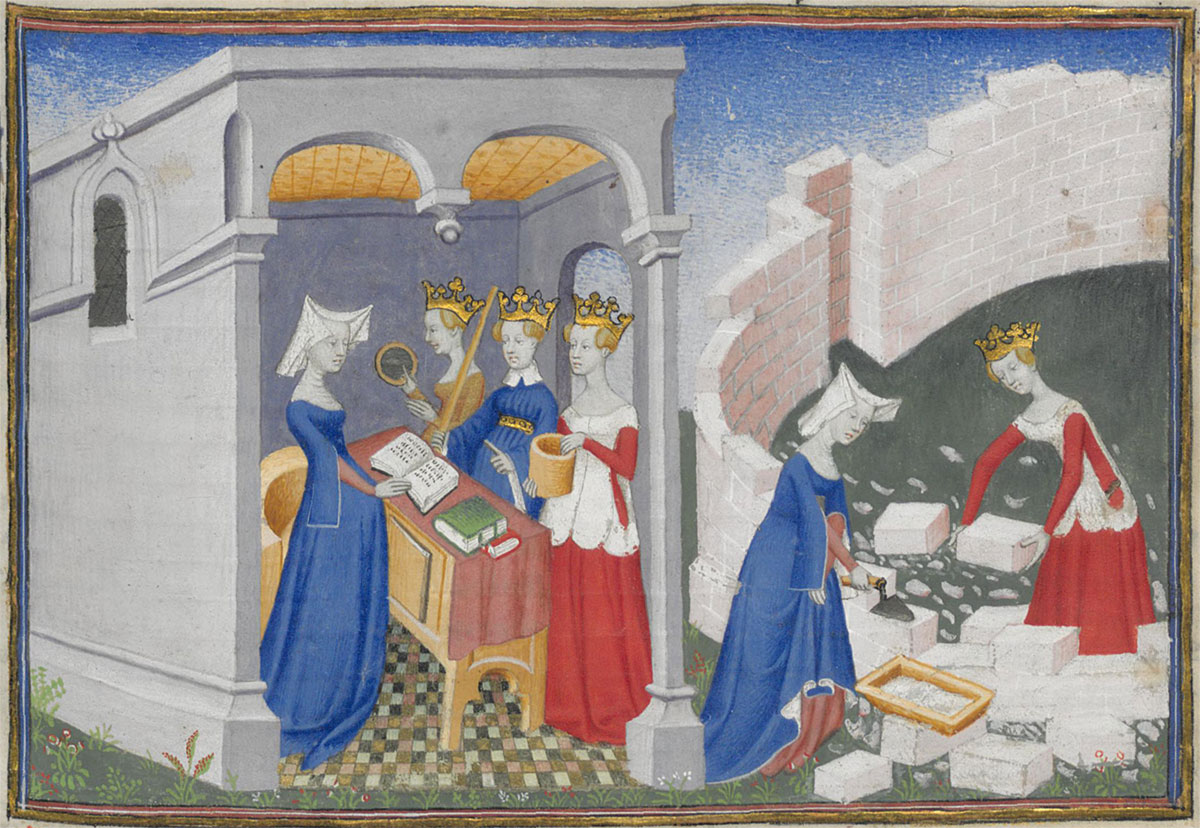
An illustration from ‘The Book of the City of Ladies’ by Christine De Pizan. On the right, women are shown building the city.
It takes a community
Indeed, as Fiona Montgomery and Christine Collete have described, the academic field of women’s history was born “under the influence” of the second wave feminist movement of the 1960s* – a movement of communities of women working together to improve the rights and representation of their fellow women.
It coincided with a broadening interest in social history, which included women-related topics, such as the family, which had previously been considered “ahistorical”. The field also attracted “self-confessed feminist historians” who wanted to “study women on their own terms”.
Sheila Rowbotham directly credited “a political movement” and “discussions in women’s liberation” as the inspiration for her 1973 book ‘Hidden from History: 300 Years of Women’s Oppression and the Fight Against It’.
Small steps, big ambitions
Nicole Bourbonnais has described how early historians of women had a dual focus. First, they looked to recognise the “critical” role women had played in key events that dominated historical studies, and which until this point, were almost exclusively dominated by histories of men: politics, wars, and revolutions. This involved writing not only about “the more visible actors” such as Joan of Arc and Sylvia Pankhurst, but also women like the peasants who had led marches during the French Revolution. Second – since the social and cultural conditions throughout history had confined a large proportion of many women’s experiences to the domestic sphere – they “expanded the limits of historical enquiry”, writing histories of family, childbearing and rearing, of work and labour politics. In so doing, Bourbonnais said, “it challenged us to rethink what counted as historically significant”.
Writing of this same early period in the development of the field of women’s history, Ann D. Gordon, Mari Jo Buhle, and Nancy Schrom Dye, said that historians of women were “redefining and enlarging traditional notions of historical significance”, and that not only were they creating “a new history of women, but also a new history”.
However, even in left-leaning, social historical circles, women’s history still had “to be argued for”. Sally Alexander and Anna Davin recalled in the inaugural issue of ‘History Workshop’ journal in 1976 that “As recently as 1971, when the suggestion was made at a History Workshop session that people working on women’s issues should meet later in the day, there was a roar of laughter”.
Gerda Lerner was willing to do the arguing. She declared the idea of women being a sub-group in history as “wrong”; that while “men have defined their experience as history and left women out”, given women had always made up at least half, sometimes the majority, of the population, history up to this period was in fact “the history of a minority” and should be seen as “merely prehistory”.
She said the stages of women’s history to date – from ‘women worthies’ or ‘compensatory history’, which focused on notable women and didn’t describe “the significance of women’s activities to society as a whole” nor “the experience and history of the mass of women”, to ‘contribution history’, which situated women, their efforts, status, and oppression within “male-defined society” – were important, but unsatisfactory. Lerner believed that to write a new history, a women’s history, there must be “new questions to all of universal history”. The next stage, she said, “may be to explore the possibility that what we call women’s history may actually be the study of a separate women’s culture” which would focus not only on women’s experiences but their consciousness, and the tensions between “prescribed patriarchal assumptions and women’s efforts to attain autonomy and emancipation”.
But alongside this call to action, others within the women’s history field began questioning whether they were focused too narrowly and separately on women.
Challenges from within
Natalie Zemon Davis acknowledged the need to write about women “to rectify the deep and longlasting bias of the historical record”, but that she and many others wanted also to make “the relations between the sexes more just”. She said: “it seems to me that we should be interested in the history of both women and men, that we should not be working only on the subjected sex”.
Joan W. Scott said gender could be used as “a way of rethinking the determinants of the relationships between the sexes”, and that by seeing the word ‘gender’ as purely “a grammatical reference” it could help historians separate biology from culture and explain change as a result of history rather than social engineering. Used in this way, she said, it supported questions about how sex-based roles and functions, and the meaning of ‘man’ and ‘woman’, varied across time and place, how rights and power intersected with masculinity and femininity, and how conforming with or fighting against these things affected people’s lives, practices, and identities. And in the process, it would “bring women from the margins to the center of historical focus”.
However, many other historians of women saw this expansion of scope as a threat to the dedicated work to recover women previously hidden from history. June Hannam described an emphasis on gender-centred history as “controversial”; that an approach which saw the interests of the sexes as similar could lead to women’s specific experiences being lost from view.
June Purvis went even further, setting out a seven-point opposition to gender history, which included concerns about turning women into “social constructs”, de-radicalising women’s history to make it “less threatening to the male establishment”, and that gender history implicitly denied the existence of patriarchy, and the existence of women as a political and subordinate class. She concluded that it was “critical” that women were kept “centre stage” to avoid “our past being pushed back into obscurity, yet again, and of being marginalized and distorted through a male lens”.
The field of women’s history faced other internal challenges, too. Like the women’s liberation movement that helped inspire it, the academy and history practitioners were criticised for a lack of diversity and intersectionality.
Sonya O. Rose described the work of women of colour as “a second major assault” (gender history being the first). She explained that writing by and about women of colour challenged the version of women being reclaimed by white Western historians as, in fact, the experiences of white, often middle-class, women; that domesticity, family structures, community bonds, and women’s role in the public sphere were different for Third World women and women of colour. These writings also promoted, Rose said, the “pivotal idea” that race, gender, and class are “interlocking and interdependent” dimensions and forms of domination. For example, Evelyn Brooks Higginbotham has described the “paradoxical nature” of black women’s identity, explaining they are “simultaneously black and female, black and American, and American and female” and that “to be black and female carries the dual burden of racial and sexual oppression”.
*It should be noted that – in line with Lerner’s assertion about women’s history needing a movement of women to thrive – the first wave feminist movement of the late 19th and early 20th centuries did inspire a series of women’s history works (one I’ve used multiple times in my own research is Alice Clark’s 1919 ‘Working Life of Women in the Seventeenth Century’). However, Hannam has said that when the women’s movement fragmented after the First World War, “these pioneering histories tended to be lost from view”. In contrast, in the mid-20th Century – even when the second wave feminist movement began to lose momentum – “the expansion of higher education opened up more jobs for women academics who were able to influence the curriculum and to introduce women’s history courses”.
The work must go on
However, I’d argue that that influence hasn’t extended far enough outside the academy. Decades on from the field’s establishment, women are still significantly under-represented in, for example:
- UK secondary school history lessons – women made up just 7% of named characters in a sample of 28 history textbooks currently in use in classrooms.
- both academic and public history outputs – from a sample of 26,697 articles, books, podcasts, and newsletters published in 2004, just 1.5% focused on women-specific topics, rising to 4.7% when considering women-specific and women-related topics.
However, as my survey of history practitioners found, at least 33% of women who do history are either explicitly or implicitly influenced by this under-representation. And while, yes, they are frustrated, even angry, about the state of the field, they are also determined to drive the change they want to see. As one of my favourite responses in the survey said: “The more the patriarchy gets me down, the harder I go”.
Women may traditionally have been excluded from the history that was recorded, but that doesn’t mean they were absent from or didn’t contribute to the making of it. They were there, and they’re waiting for us to uncover and tell their stories.

Sources:
- Aitken-Burt, Laura, Initial Analysis of Characters Listed in History GCSE and A Level Specifications for AQA, Edexcel and OCR (2025), doi:10.5281/zenodo.15620013.
- Alexander, Sally and Anna Davin, ‘Feminist History’, History Workshop, 0.1 (1976).
- Bourbonnais, Nicole, ‘A Brief History of Women’s History’, London School of Economics (2016)
- Brooks Higginbotham, Evelyn, ‘Beyond The Sound of Silence: Afro-American Women in History’, Gender & History, 1.1 (1989).
- Gordon, Ann D., Mari Jo Buhle, and Nancy Schrom Dye, ‘The Problem of Women’s History’, in Liberating Women’s History: Theoretical and Critical Essays, ed. by Berenice A. Carroll (1976).
- Hannam, June, ‘Women’s History, Feminist History’, Making History, the Changing Face of the Profession in Britain, The Institute of Historical Research.
- Lerner, Gerda, The Creation of Feminist Consciousness: From the Middle Ages to Eighteen-Seventy (1993).
- Montgomery, Fiona and Christine Collette, The European Women’s History Reader (2002).
- Purvis, June, ‘From “Women Worthies” to Poststructuralism? Debate and Controversy in Women’s History in Britain’, in Women’s History: Britain, 1850-1945 : An Introduction (1995).
- Rose, Sonya O., ‘Gender History/Women’s History: Is Feminist Scholarship Losing Its Critical Edge?’, Journal of Women’s History, 5.1 (1993).
- Rowbotham, Sheila, Hidden from History: 300 Years of Women’s Oppression and the Fight against It, 3rd edition (1977).
- Scott, Joan W., ‘Gender: A Useful Category of Historical Analysis’, The American Historical Review, 91.5 (1986); Gender and the Politics of History, revised edition (1999).
- Zemon Davis, Natalie, ‘“Women’s History” in Transition: The European Case’, Feminist Studies, 3.3/4 (1976).