When the Royal Academy of Arts (RA) was founded in 1768, it – perhaps surprisingly for the period – had two women members: painters Mary Moser and Angelica Kauffman.
However, I get the sense they weren’t as highly regarded as I’d like to believe.
A painting commemorating the founding members was set in the Life Drawing Room, which women could not enter, so Moser and Kauffmann were depicted as portraits on the right-hand wall, rather than actual people in the scene. Also, they weren’t allowed any role in the RA’s governance.
It would be another 168 years before the next woman, painter Laura Knight, was elected as a full Academician in 1936. And it wasn’t until 1967 that women were invited to the RA’s annual dinner.
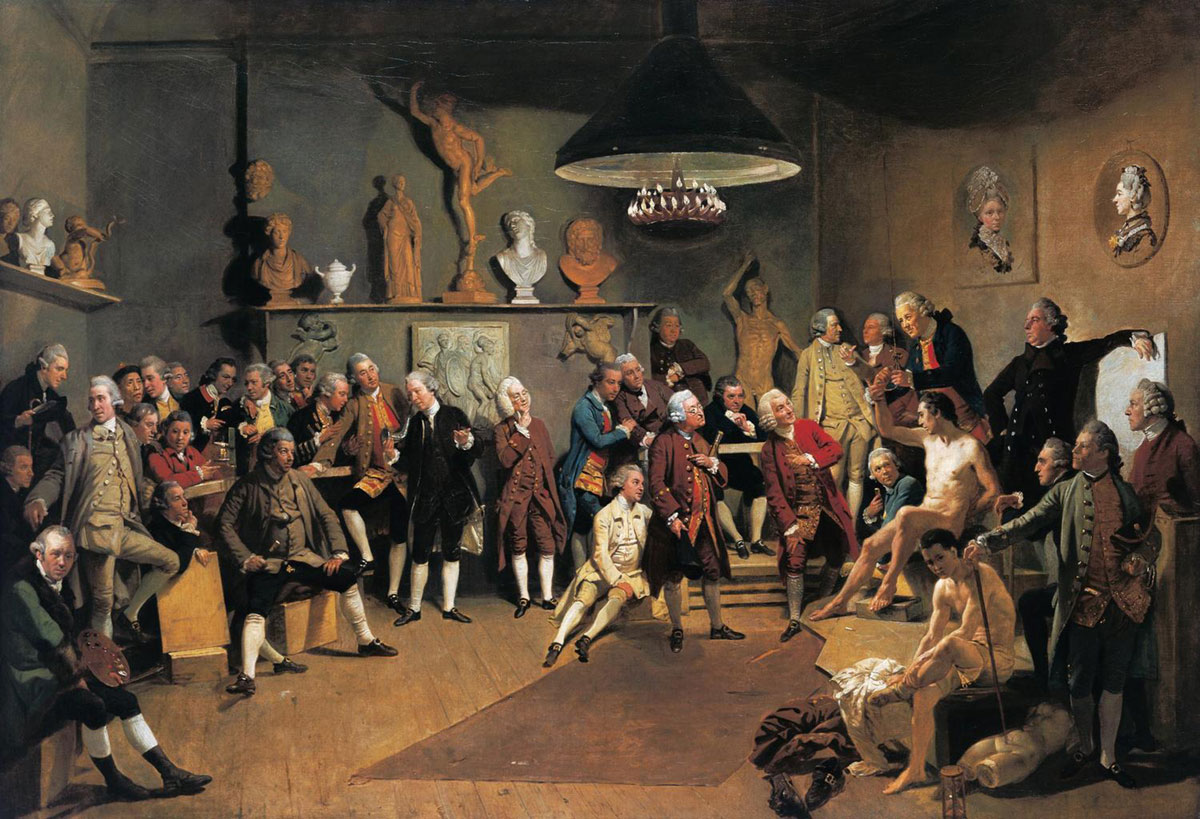
‘The Portraits of the Academicians of the Royal Academy, 1771-72’, oil on canvas, by Johan Zoffany. (Public domain.)
Amid this backdrop, it’s not surprising that art considered too feminine was excluded by the RA. In 1770 it banned “Needle-work, artificial Flowers, cut Paper, Shell-work, or any such baubles” from its exhibitions. They were considered crafts and therefore “lower arts”. Joshua Reynolds, the RA’s president at the time, described such artforms as “just what ladies do […] for their own amusement”.
Enter Mary Linwood to prove that belief wrong.
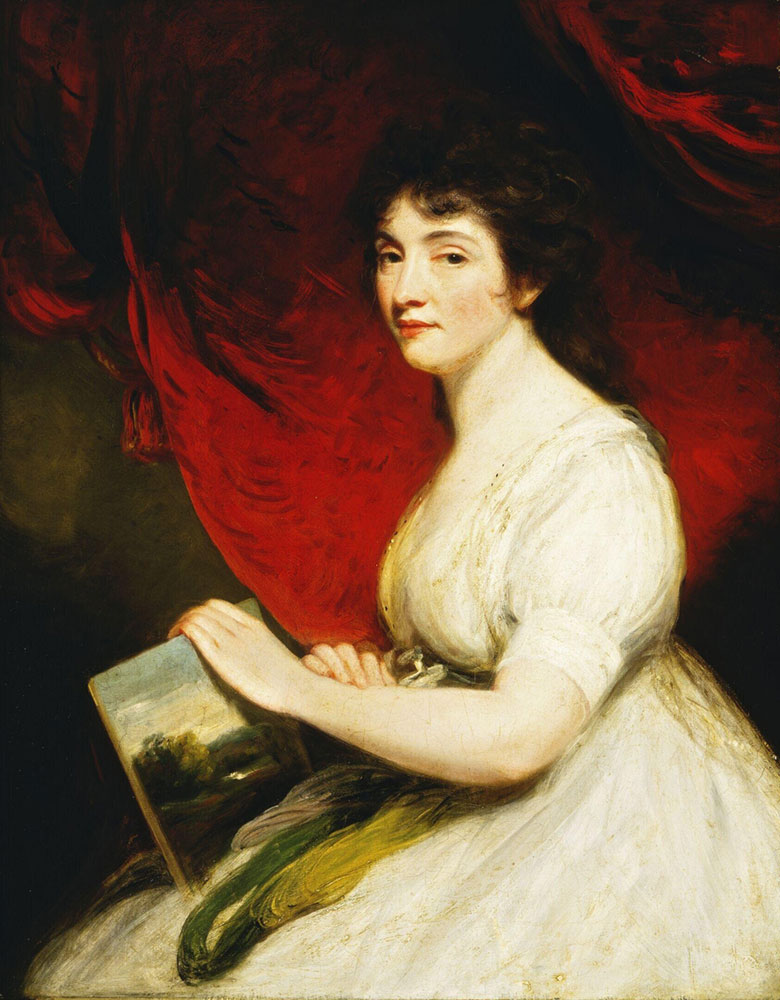
‘Miss Mary Linwood, Artist in Needlework’, oil painting, c.1800, by John Hoppner (a Royal Academician!). Image © Victoria and Albert Museum, London.
Linwood (1755-1845) was a needlework artist who expertly rendered brush strokes in stitches in her detailed embroidered versions of famous paintings. She worked with wool on linen cloth, using hundreds of colours, different thicknesses of thread, and different lengths of stitch, to create texture and depth. The technique was called ‘needle painting’. The Victoria & Albert Museum in London (V&A) describes Linwood as “the most renowned practitioner” of the art.
She began exhibiting her artworks in her twenties, and in 1786 was awarded a medal for her ‘The Head of King Lear’ embroidery (ironically, after an original painting by Joshua Reynolds!) by the Society for the Encouragement of Arts, Manufactures and Commerce.
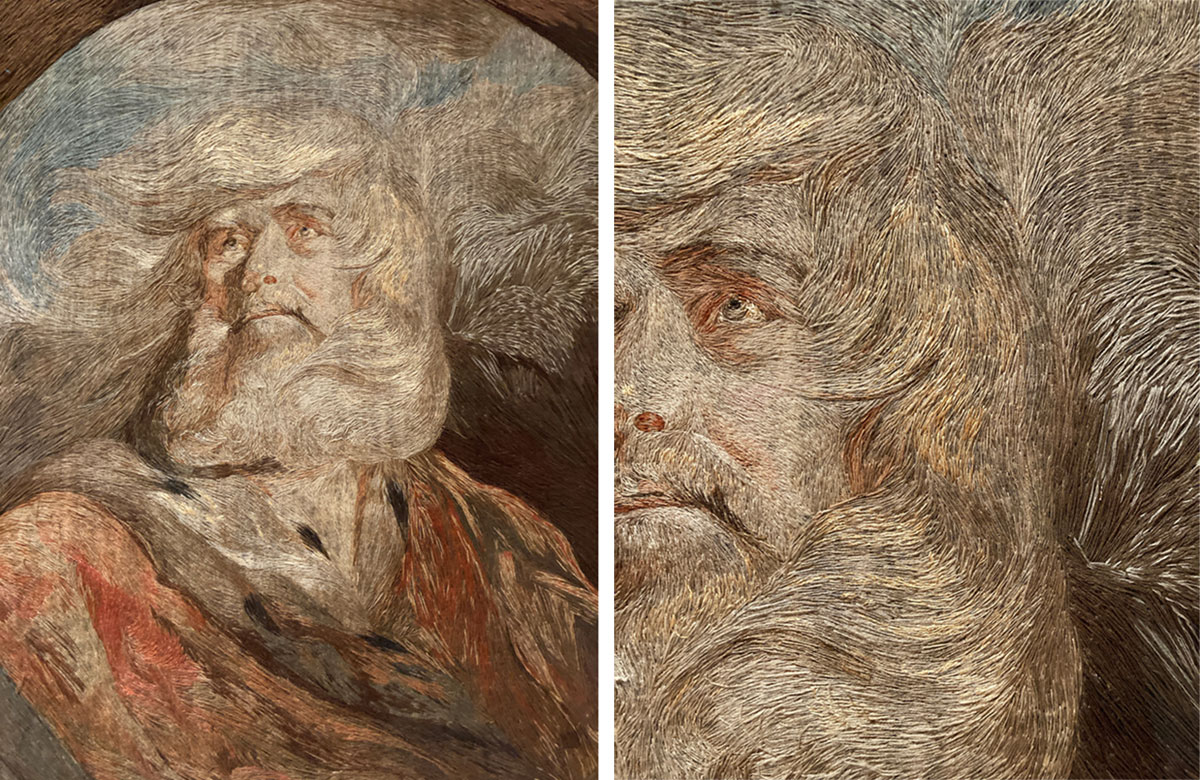
Linwood’s award-winning ‘The Head of King Lear’, left; and detail, right. It was part of an exhibition at Leicester Museums from September 2025 to February 2026 which explored her life, art, and legacy. Photographs courtesy of Soraya Smithson.
In 1787 Linwood held her first solo exhibition in London. Between 1798-1901 she had a semi-permanent exhibition at Hanover Square Concert Rooms in London, which then went on tour to Scotland, Ireland, and “the chief provincial towns”.
A 1798 newspaper article about the Hanover Square exhibition said: “[…] the world has never witnessed a more striking monument of genius and application, than this truly surprising and admirable collection. The astonishing effect in so many varied styles of subject, their accurate resemblance to the original paintings, and happy distribution, make [it] one of the most agreeable recreations afforded by the Metropolis.”
By 1809 Linwood had bought property on Leicester Square in London and created her own permanent exhibition space. It was the first gallery in the UK owned and run by a woman (and the first art exhibition to be illuminated by gas light).
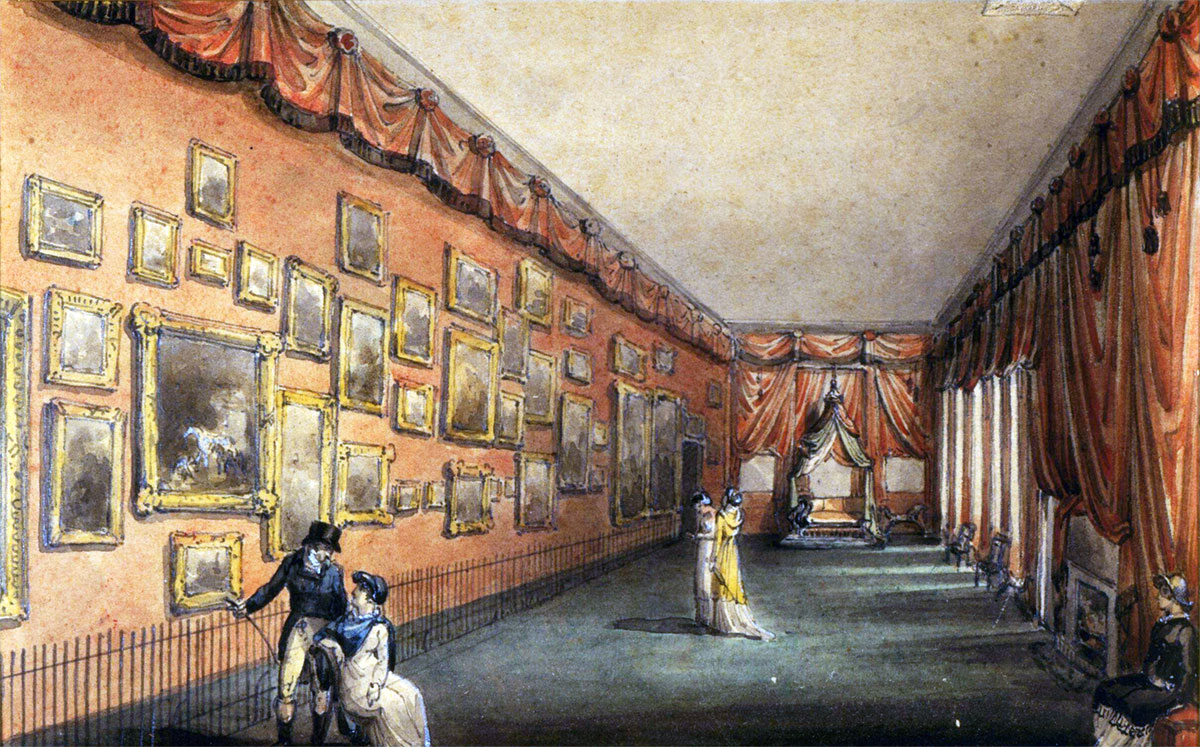
‘View of Mary Linwood’s gallery’, watercolour, c.1810. Image © Victoria and Albert Museum, London. The railing along the gallery wall was to “keep the company at the requisite distance for properly viewing” the art.
A contemporary guidebook to London ‘exhibitions, public establishments, and remarkable objects’ described the gallery as displaying “between sixty and seventy exquisite copies, in needle-work, of the finest pictures of the English and foreign schools”. As well as the “principal room” – “a fine gallery, of excellent proportions, hung with scarlet broad cloth, and gold bullion tassels, and Greek borders” with art on one side and windows and seating on the other – Linwood’s gallery included a small room made up like “the cell of a prison” which housed her version of James Northcote’s picture of Lady Jane Grey on the eve of her execution, and another “tasteful room, or boudoir” devoted solely to her recreation of Carlo Dolci’s ‘Salvator Mundi’. Other art on display included thread paintings of works by Reynolds, Thomas Gainsborough, and Italy’s Raphael.
The guidebook author, John Feltham, said it was difficult to “single out the best pieces from among so much excellence”.
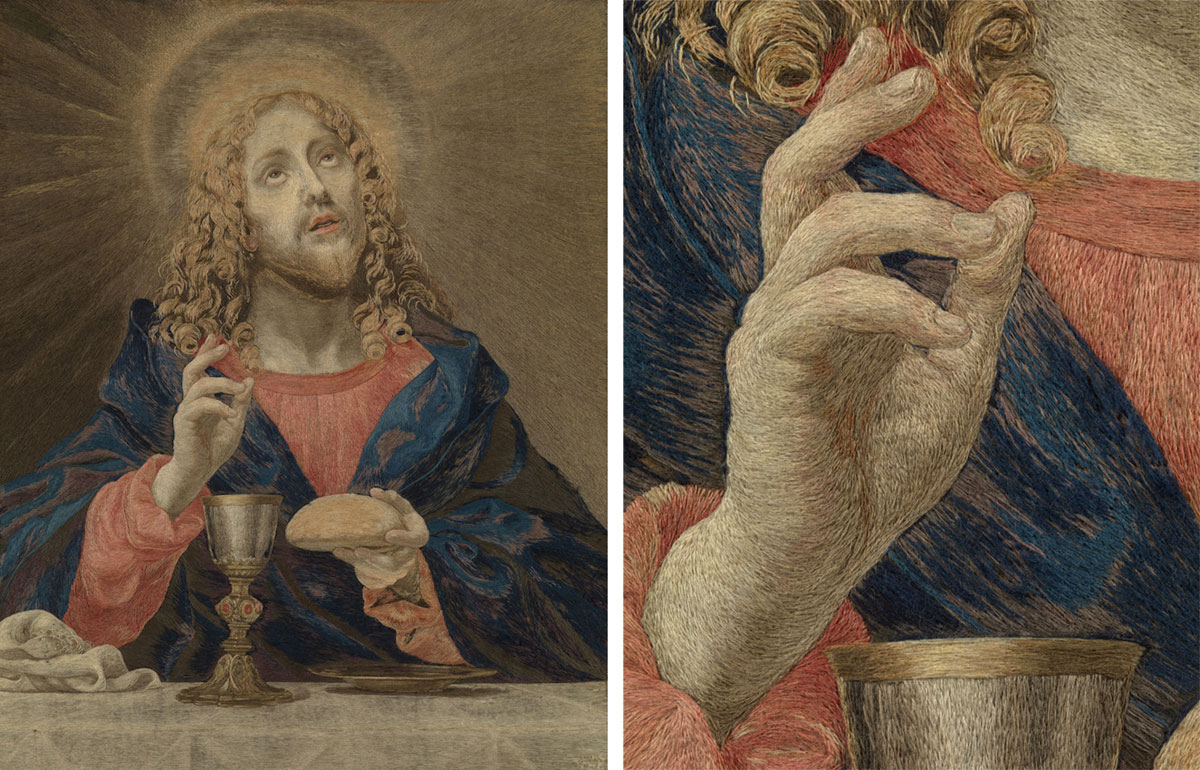
‘Salvator Mundi, after Carlo Dolci’, c.1798, by Mary Linwood, left; and detail, right. Image courtesy of the Royal Collection Trust / © His Majesty King Charles III. Linwood’s Dictionary of National Biography entry says this work “was regarded as her masterpiece”. She left it to Queen Victoria and it remains in the Royal Collection.
Linwood’s gallery was a hit. It was open from 10am until dusk, and visitors were charged two shillings and sixpence to enter (just over £9 in today’s money). So popular and profitable was it, that in 1813 Linwood was able to donate £155 (£9,500 today) to the infirmary in her hometown of Leicester from “the sums received from the Exhibition of [her] much admired Works”.
A newspaper article typical of the praise Linwood’s work and gallery received described her in 1840 as “the ingenious artiste whose pictorial embroidery has thrown perennial fame around the region of Leicester-square”.
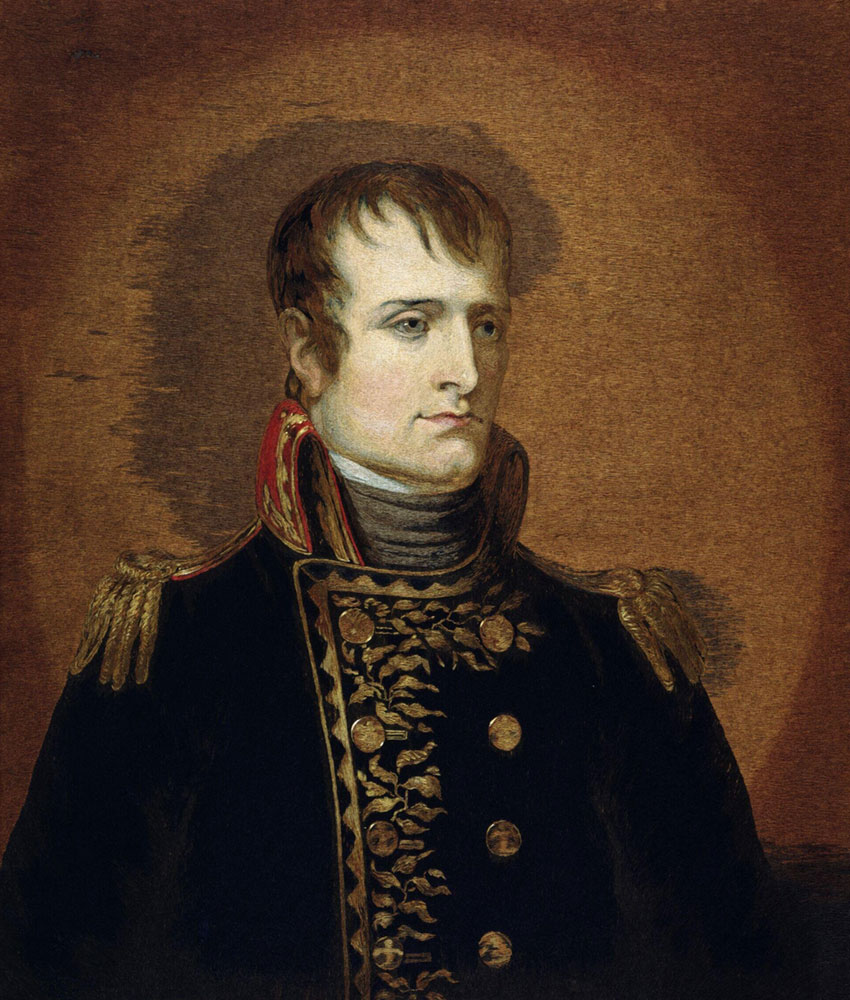
‘Napoleon Bonaparte’, needlework by Mary Linwood, 1825. Image © Victoria and Albert Museum, London.
The gallery remained open for over 35 years, until Linwood’s death in 1845. Obituaries for her appeared in at least 26 newspapers across the UK, describing her as “one of the most gifted and remarkable women of the age in which she lived”.
Linwood rarely chose to sell her work and only around 20 pieces by her are known to exist today.
When she died, the contents of her gallery was actioned (curiously, the sale achieved much less than the praise Linwood and her work received during her lifetime would have suggested – making only around £1,000, or £107,000 in today’s money).
But this had little impact on the legacy she left her extended family, friends, and charities. Linwood’s estate was worth over £45,000 (about £4.8million), a fortune made largely from her art gallery ticket sales.
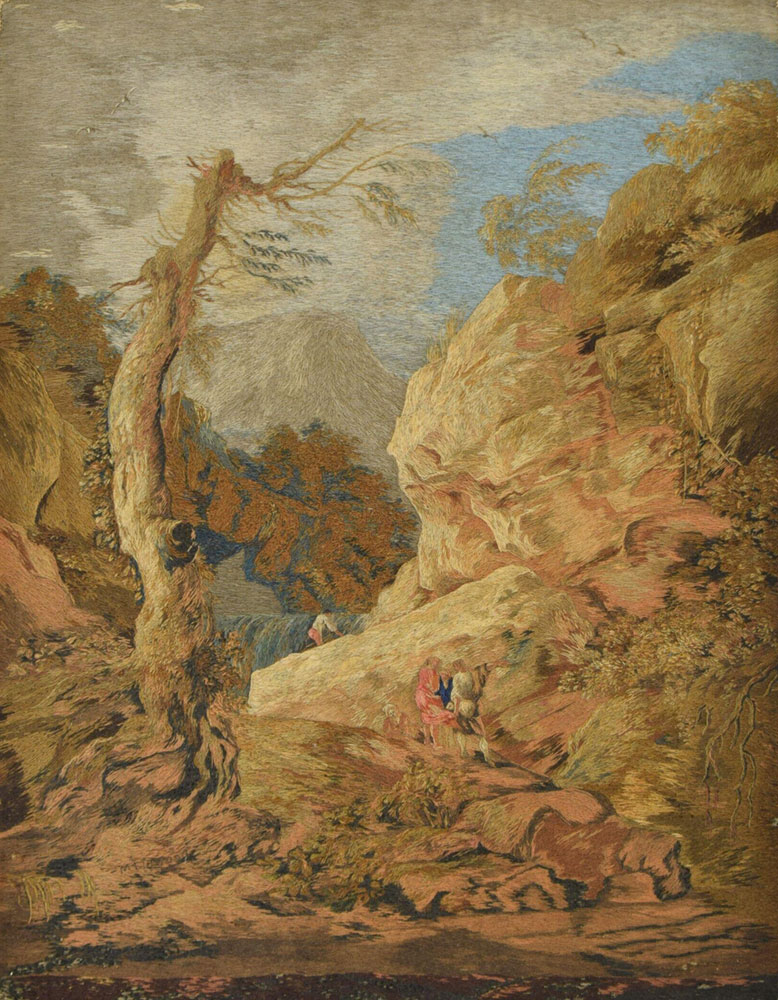
‘Picture of embroidered worsted with landscape after painting by Salvator Rosa’, by Mary Linwood, 1790-1819. Image © Victoria and Albert Museum, London. It’s not clear if this is the exact piece they’re talking about, but the V&A says: “On one occasion her copy of a painting by the Italian artist Salvator Rosa was sold for more than the original”.

Sources:
- ‘A brief history of the RA’, The Royal Academy.
- Aris’s Birmingham Gazette, 26 March 1798, via The British Newspaper Archive.
- John Feltham, The picture of London, for 1810; being a correct guide to all the curiosities, amusements, exhibitions, public establishments, and remarkable objects, in and near London (1810).
- Leicester Journal, 5 February 1813, via The British Newspaper Archive.
- ‘Leicester Square, North Side, and Lisle Street Area: Leicester Estate, Leicester House and Leicester Square North Side (Nos 1-16)’, Survey of London: Volumes 33 and 34, St Anne Soho, ed. F H W Sheppard (1966), via British History Online.
- ‘Mary Linwood Art, Stitch & Life’, Leicester Museums & Galleries (2025-2026).
- ‘Miss Mary Linwood, Artist in Needlework’; ‘View of Mary Linwood’s gallery’, Collections – Victoria and Albert Museum.
- Morning Herald (London), 6 May 1840, via The British Newspaper Archive.
- The Patriot, 10 March 1845, via The British Newspaper Archive.
- William Cosmo Monkhouse, ‘Linwood, Mary, Dictionary of National Biography, Volume 33 (1885-1900).
- ‘Now You See Us: Women Artists in Britain 1520-1920’, Tate Britain (2024).
- Amanda Vickery, ‘Hidden from history: the Royal Academy’s female founders’, RA Magazine, Summer 2016.