Below you will find links to some interesting history-related articles I’ve read (and watched) recently, a photo of a historic artefact that’s recently come into my possession, and an item about the history/practice of writing.
Enjoy!
History writing
- Unique (and newly digitised!) 19th Century journals by Ella Sheldon, a woman who worked as a stewardess on steamships travelling around the world.
- The 14th Century ‘Black Death’ plague was undoubtedly a dark and terrible time, but as Helen Carr explains, it also ushered in a period of significant social, economic, and technological change; a period of prosperity, growth, and light.
- I regularly liken being a historian to being a detective, so I’m always drawn to a good ‘hunt/discovery’ story – like this professor’s search for a prototype Chinese typewriter.
- Another hunt, of a sort – the Italian artist who sought out and recreated historic tarot decks; his story is told within this wider piece on the history of tarot.
- Pair with the Victoria & Albert Museum’s video about tarot cards in their collection.
History
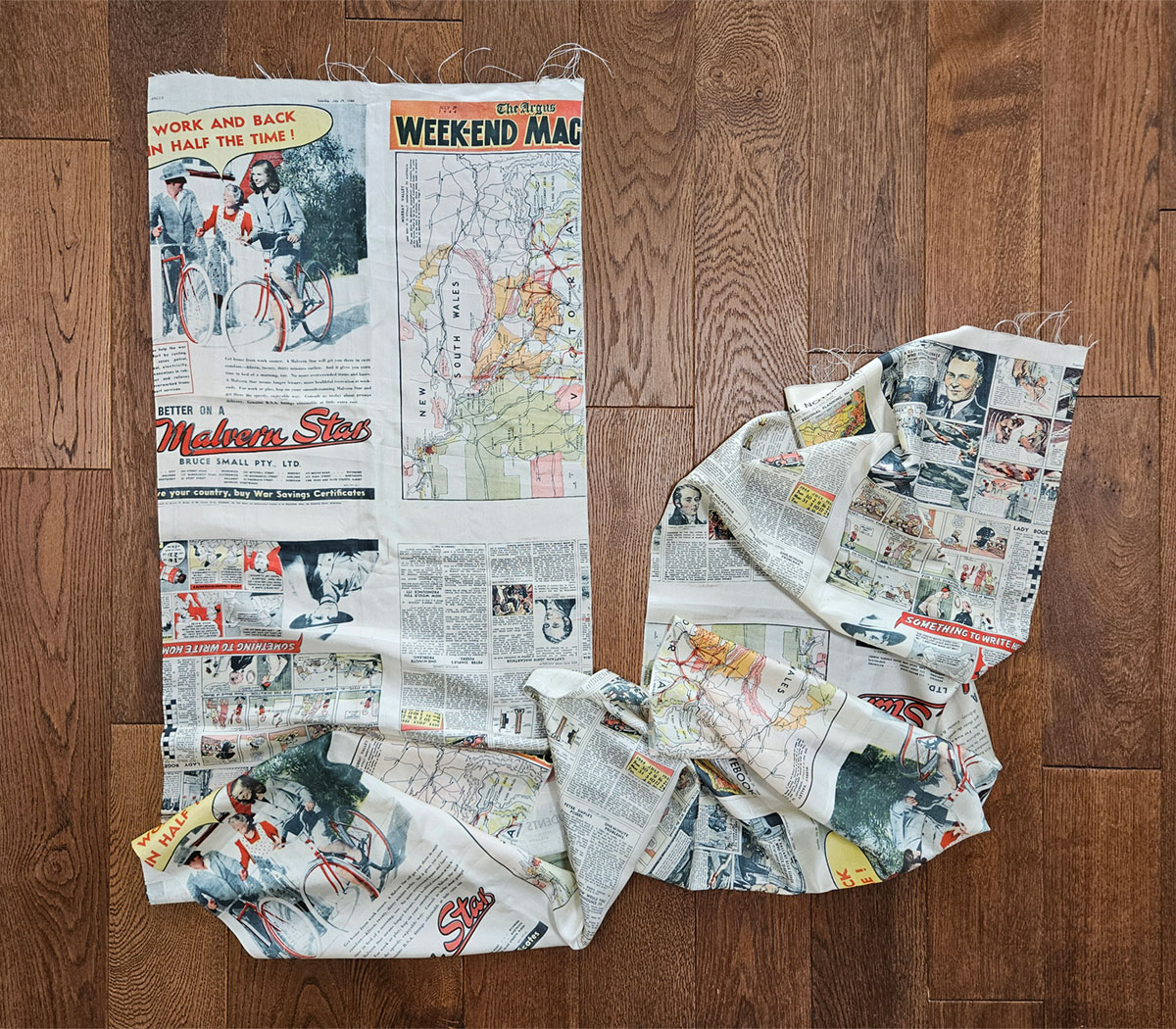
Newspaper pages from 1944 printed on a length of silk fabric as a test ahead of printing silk air force maps.
Almost 81 years ago to the day, my maternal great grandfather, William Charles Thompson, stood in the press room of The Argus, a newspaper in Melbourne, Australia, overseeing an experimental test print for new operational and ‘escape and evasion’ maps for pilots. At the time he was working at the Royal Australian Air Force (RAAF) in charge of ‘Map Section’, in between taking leaves of absence to serve as a pilot fighting against Japan (promoted to Flight Lieutenant and then Squadron Leader along the way).
After Japan entered the Second World War in late 1941, quickly taking control of most of southeast Asia – and attacking Australia – the United States ‘assumed responsibility’ for Australia’s defence, providing reinforcements and equipment. My great grandfather, who had previously trained in surveying, draughting, and mapping, led on the supply of updated maps to both country’s air forces.
In 1944, he came up with an idea for printing the silk maps more quickly and cheaply: by feeding rolls of fabric through a rotary printing press (rather than printing them individually on pre-cut fabric). He used pages from The Argus’ 29 July 1944 weekend magazine – which featured a map – to test the quality and legibility of the method. It was a success.
I was lucky enough to be recently given one of the newspaper test prints (pictured above), which measures 46x280cm.
My great grandfather was awarded an MBE in June 1945 in recognition of his work in charge of Map Section. His son, also called William, quoted the citation in a family biography: “At the outbreak of war, the Royal Australian Air Force possessed a series of most inadequate aeronautical maps of Australia, and practically none of the areas northward of the Continent, and it is due to Squadron Leader Thompson’s organising ability and technical skills that the Service is now in possession of an adequate series of Aeronautical and Navigational maps and charts for the whole of the area including Australia and southeast Asia up to Japan. Since the advent of the American Air Force into this theatre, they have exclusively used the Royal Australian Air Force maps and charts in preference to their own standard productions […] Squadron Leader Thompson has administered his important section with marked ability and enthusiasm. The excellent results produced have been of considerable assistance to Air Operations in this theatre.”
Here’s a picture from September 1944, once RAAF silk map printing at The Argus was officially rolled out. That’s my great grandfather on the right.
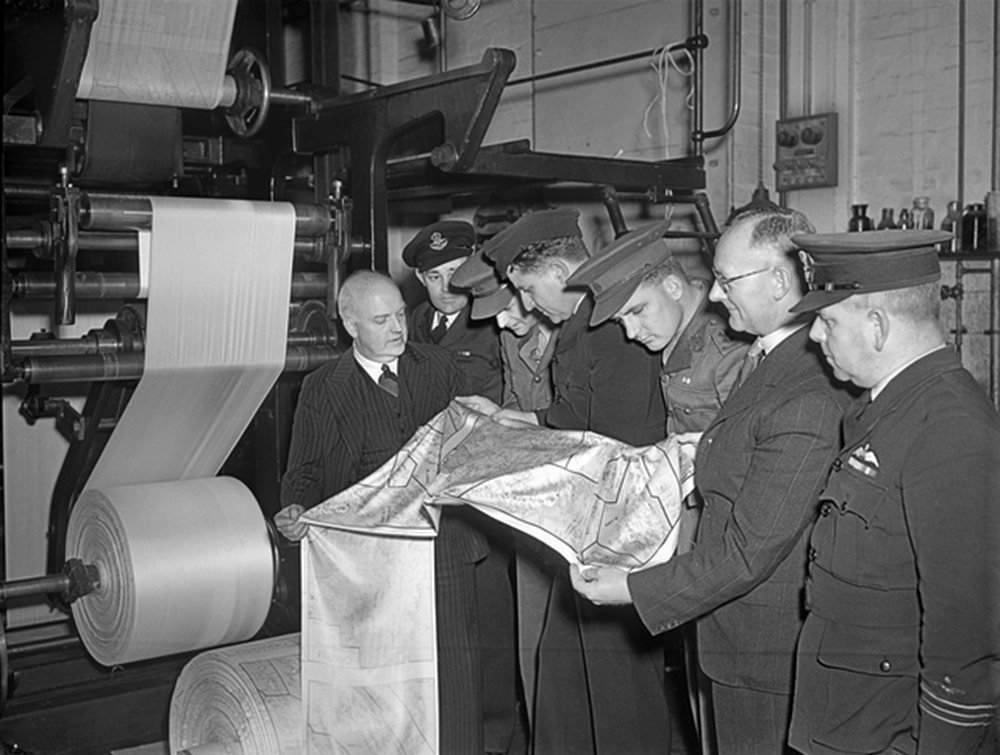
1 September 1944: a group of servicemen and officers of The Argus inspecting silk maps produced by the newspaper in co-operation with the RAAF. Image courtesy of the Australian War Memorial.
Writing
Are emojis a language? The Oxford English Dictionary did, after all, declare ‘face with tears of joy’ (😂) its 2015 ‘word’ of the year?! This article investigates, with some interesting discussions of orthography, grammar, scripts, rebuses, and more.