At the end of last fortnight’s story, I shared my observations from walking John Stow’s description of the bounds, main roads, and branching streets and alleys of Aldgate Ward in the City of London.
Something I didn’t mention then was the former property of a ‘Mistris Cornewallies’. Stow’s passage – part of his description of Aldgate Street (now Leadenhall Street) – reads in full:
“Then is there a faire house, with divers Tenements neere adjoining, sometime belonging to a late dissolved Priory, but since possessed by Mistris Cornewallies, widow, and her heires, by the gift of King Henry the eighth, in reward of fine puddings (as it was commonly said) by her made, wherewith she had presented him: such was the Princely liberality of those times.”
I have discovered that the ‘Mistris’ was called Alice and her surname is the pre-standardised spelling of Cornwallis.
Now, it’s no secret that King Henry VIII liked his food (a suit of armour made for him in 1540 puts his waistline around 138cm). But even so – and even considering “the Princely liberality of those times” – Alice Cornwallis must have made some damn fine desserts to warrant the gift of a house and land.
Could Stow’s account really be true, or was it a case of a story being embellished and/or corrupted over time? After all, King Henry VIII had been dead more than 50 years when the first edition of Stow’s ‘Survey’ was published.
I’m always drawn to stories of women who had some agency, or control (eg: property ownership), in periods when they were generally under the legal, financial, and even bodily, authority of first their fathers and then their husbands. So, I was intrigued to investigate further.
And reader, hold on, because it gets more liberal yet.
But first…
Who was Alice Cornwallis and what did she do?
As I’ve written about before, the historic record is overwhelmingly silent when it comes to the details of the lives of ordinary women from the past. As such, I can’t tell you when or where Alice was born.
The earliest reference to her I’ve found is in the records of Privy Purse Expenses of Henry VIII from October 1530 for a payment “To the wife that makes the King puddings at Hampton Court, 6s. 8d.” (That’s about £250 in today’s money, according to the Bank of England’s conversion tools.)
Only six women are known to have been employed indoors in Henry VIII’s household. Alison Sim has written that this was typical of the upper classes in the Tudor period. It cost more to employ men than women, so having a house full of male staff was a status symbol. The names of just two of Henry VIII’s women staff are known to us today: Anne Harris, who worked in the Laundry, and Alice Cornwallis, who worked in the Confectionary, one of more than a dozen departments of the royal kitchen. (Others include familiar names such as the Cellar, Bakehouse, Pantry, and Larder, plus the more whimsical Spicery, Saucery, Buttery, and Wafery.)
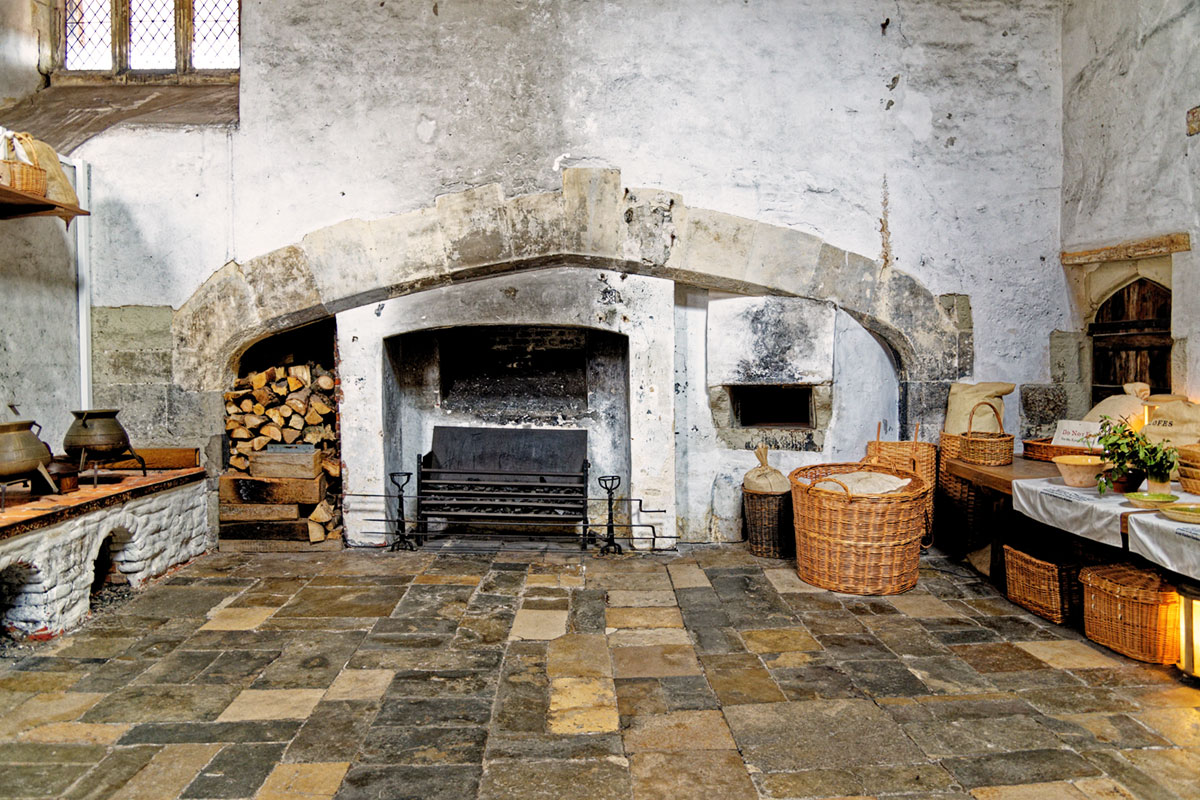
One of the kitchen rooms at Hampton Court Palace. Image: Ion Mes / Shutterstock.com.
Tracy Borman, Chief Historian for Historic Royal Palaces, wrote in her book, ‘The Private Lives of the Tudors’, that Henry VIII “so loved [Alice’s] sweet treats”, and listed “custards, fritters, tarts, jelly, cream of almonds and a quince marmalade so thick that it could be sliced” as among his favourite of her recipes.
And excitingly for our purposes, Borman endorses Stow’s account that Henry VIII rewarded Alice for her culinary skills with property in Aldgate.
The “Princely liberality” of Henry VIII’s property gifts
Following a further sift through the letters and papers of Henry VIII and later monarchs, I found six references to Alice, and her husband Edward, and properties in the City of London. They relate to two initial gifts.
I spoke to historian and author Caroline Angus to help me understand these 16th Century records. Angus has transcribed and published the letters and other writings of Thomas Cromwell, Henry VIII’s ‘faithful servant and agent’, so knows about the administration of the country around this time.
The first property gift, granted in 1540, was to “Edw. Cornewallis and Alice, his wife” of “the great messuage called the ‘Principall place’ and garden adjoining […] in the parish of St Katharine Cristchurche in London, which belonged to the late monastery of Evesham, Worc” as well as “messuages, lands, &c., in the parish of St. Dunstan in the East, London, which belonged to the said monastery”. (A ‘messuage’ is a house with outbuildings and land.)
This ‘Principall place’ matches the location and description that Stow gives in his ‘Survey’. It would have been located somewhere between what is today an alley called Fenchurch Buildings and Billiter Street. A map of Tudor London c.1520, created by modern historians and archaeologists, shows ‘The Abbots of Eversham’s Inn’ (the said dissolved priory) occupying the same area.
Today the site is home to a towering steel and glass high-rise:

I had to use some extreme reverse zoom to fit the building in a single shot.
The second property gift, granted in 1543, was for “Nine messuages in the parish of St. Katherine Christchurch, and two in that of St. Alban, Wood street, London […] and six in St. Clement’s lane in the parishes of St. Clement within the city and St. Andrew Undreshaft, London”. And what’s interesting about this one – aside from the scale of the gift – is that in this and later references to it, Alice is explicitly named as the sole recipient, with Edward only mentioned for context (eg: “Alice Cornewalles, wife of Edw. Cornewalles”).
So, it wasn’t just one property in Aldgate that Alice was gifted, but 15, in multiple locations (including Aldgate) across the City of London. They must have been damn fine desserts, indeed!
The gifts were initially to receive the rental income from the properties during their lifetimes, but in 1544 and 1545, they were granted the freeholds to the properties and those who would’ve previously received the rental income rights back after Alice and Edward’s deaths were paid out by the Crown. There are further references in the records to Edward and Alice selling some of the properties.
At the time of her death in January 1556, Alice – by then a widow and mother to a 24-year-old son, Thomas – was still in possession of the ‘Principall place’ off Aldgate (now Leadenhall) Street.
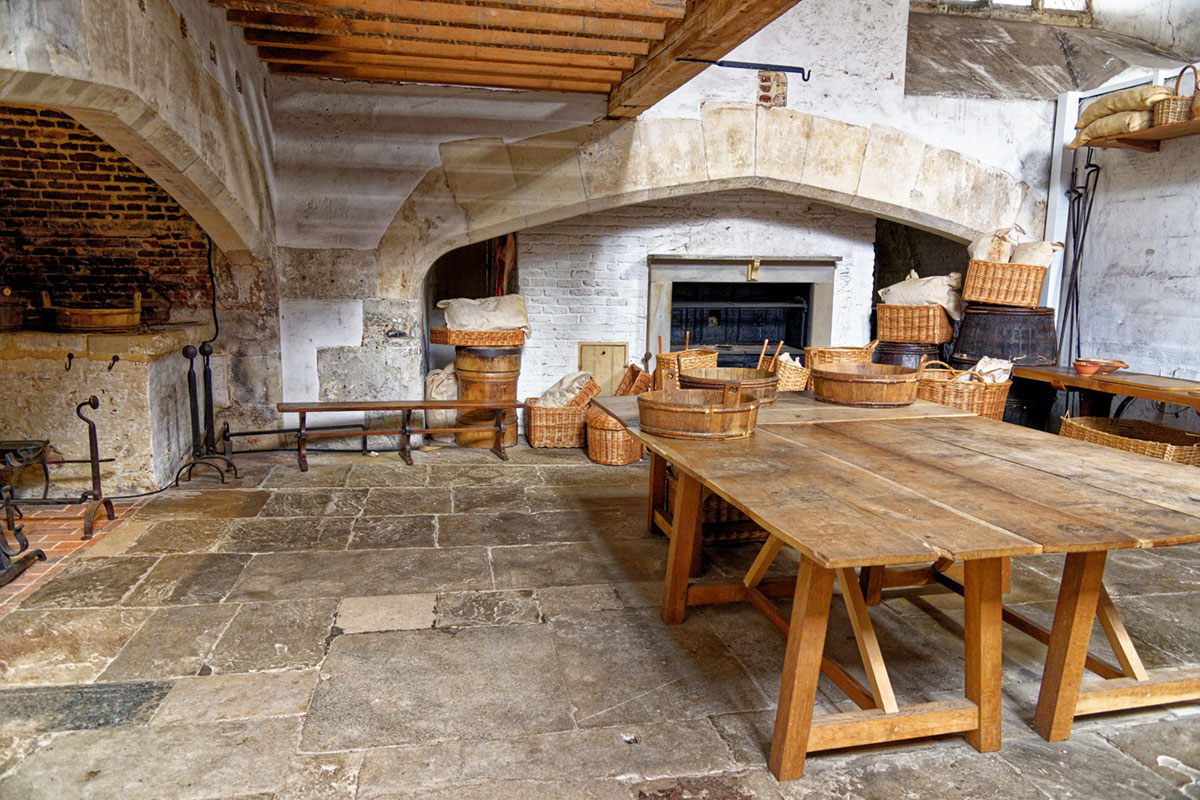
Another part of the kitchen complex at Hampton Court Palace. Image: Ion Mes / Shutterstock.com.
The records I have access to don’t explicitly mention puddings or Alice’s role as Confectionary kitchen staff in relation to the property gifts. But are the dots big enough and close enough to join? Those with much closer proximity than me to the people (Stow) and the places/systems involved (Borman) certainly thought so. And does it matter that the specific property Stow mentions as being gifted for ‘fine puddings’ appears to be the one given to Alice alongside her husband, rather than one of the 15 given exclusively to her? Probably not in the grand scheme of things (and who’s to say the joint gift wasn’t also for the puddings, anyway).
What does it all mean?
Alice Cornwallis was a non-elite woman whose culinary skills shone brightly enough, even from her service-level position, to catch the palette and the attention of a king. She was rewarded with property across the City of London, which she controlled for a decade and a half, and ensured a healthy inheritance for her son.
470 hundred years later, I’m saying her name, recounting her story, and celebrating her good fortune. That’s more of a legacy than most of us can probably expect.

References:
- Tracy Borman, The Private Lives of the Tudors: A revelatory glimpse into the lives of Henry VIII, Anne Boleyn, Elizabeth I and more (2016).
- G S Fry, ed. (1896), ‘Abstracts of Inquisitiones Post Mortem For the City of London: Part 1’, British History Online.
- James Gairdner, ed. (1880), ‘Letters and Papers, Foreign and Domestic, Henry VIII’, British History Online.
- C L Kingsford, ed. (1908), A Survey of London. Reprinted From the Text of 1603, British History Online.
- Alison Sim, Food and Feast in Tudor England (2005).
- John Stow, A Survey Of London / The Survey of London (1598 and 1633).
- Alison Weir, Henry VIII: King and Court (2011).