The Oxford English Dictionary is the largest reference tool of its type in the world. Today it’s in its third edition. The first part (or ‘fascile’) of the first edition – which covered A to Ant – was published in 1884. It was unique among dictionaries at the time in being diachronic (describing the history and evolution of words and their use) rather than synchronic (describing only current spellings, meanings, and use).
Compiling such a dictionary wasn’t a task that one person, or even one professional team, could do alone. And so, in an early example of a crowd-sourced project, between 1858 and 1928 the public was invited to read books and send in examples of how words were used, written on 4x6inch pieces of paper which came to be called ‘slips’. The Oxford English Dictionary (EOD) archives still hold all 2million slips submitted by around 3,000 contributors from across the world.
What was interesting to me – as Sarah Ogilvie described in her book, ‘The Dictionary People’, and in a talk on the subject she recently gave at Gresham College – is that: “the project attracted autodidacts and amateurs rather than professionals”. She lists some of their jobs, hobbies, and crimes as factory inspector, rain collector, suffragist, naturist, vicar, and murderer (there were three of the latter!). Among the total was 487 women (16% of contributors).
Ogilvie briefly mentions that one of those women was a Miss Pearson, who, in the late 19th Century, lived in southwest London. What piqued my interest was Ogilvie’s suggestion that Pearson possibly worked as a servant.
The juxtaposition of service work and contribution to “the most prestigious scholarly project in the world” fascinated me. I wanted to know more about this Miss Pearson!
The evidence
Ogilvie was inspired to write her book by the chance discovery in 2014 of address books belonging to the late James Murray. He was the longest-serving editor of the OED, from 1879 to 1915. He’d originally hoped to finish the project in 10 years, then 16 years, then by his 80th birthday in 1916 (he died in 1915 when the project was up to words beginning with ‘Tw’). The final volume of the first edition of the EOD was published in 1928.
Pearson is recorded at two locations in Murray’s address book: 24 and 22 Westbourne Place, Eaton Square. It’s not clear whether the 24, which is crossed out, was a mistake, or if she moved two doors down the road at some point during her contribution period.
Other than her surname and address (and we can infer she was a single woman from the use of ‘Miss’ as her title), there is no other information in the OED archives about Pearson, not even her first name.
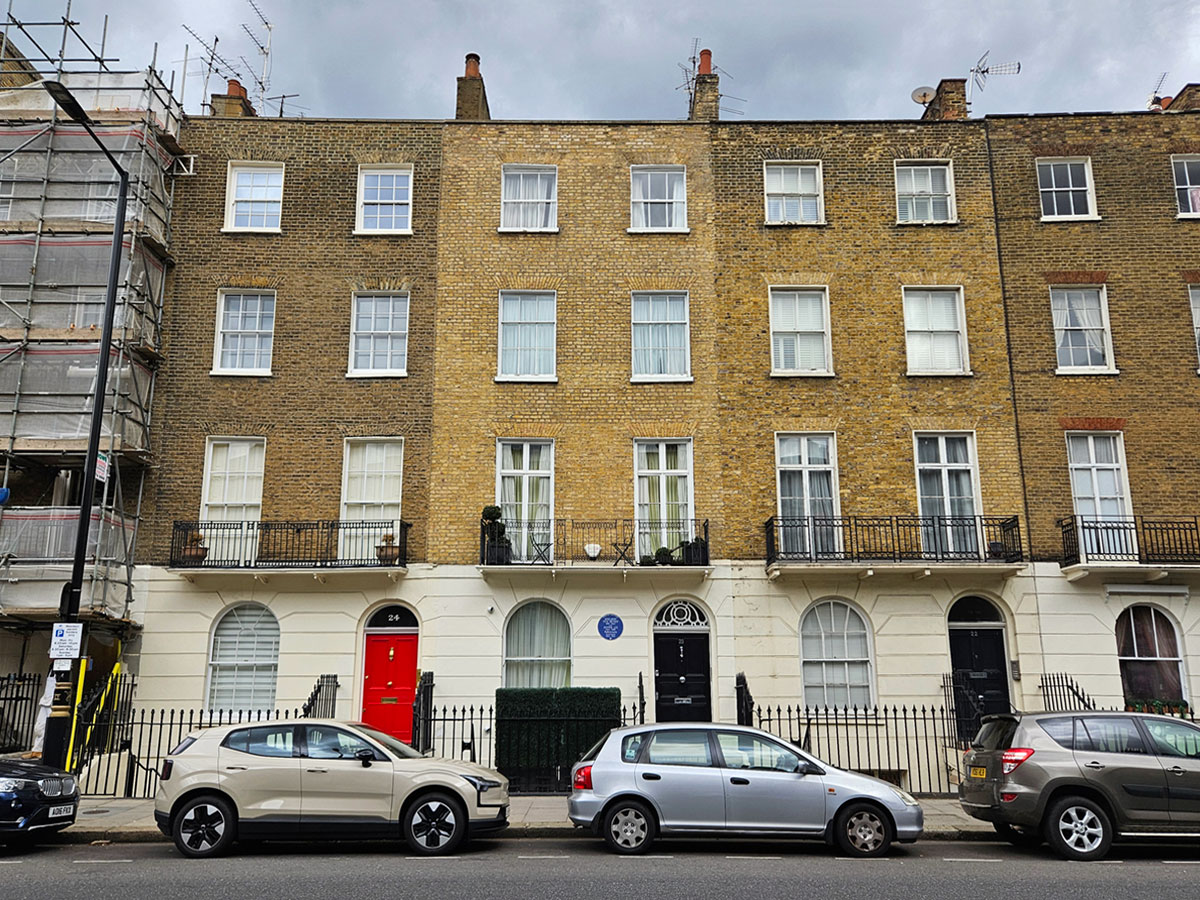
Numbers 24 (red door) to 22 Westbourne Place (now Cliveden Place) today.
But the address book entry does reveal a little more. Murray wrote that between 1879 and 1884 Pearson submitted 2,150 slips. While this is far from the highest number of submissions (that honour goes to Thomas Austin Jr who submitted 165,061 slips), her contribution was sizable and important enough that Murray mentioned her by name in both his Presidential Address to the Philological Society in 1884 and the preface to volume 1 of the dictionary (which covered A-B), published in 1888.
What further piqued my interest was the list of books Pearson read: two histories of religion, one history of England, as well as four volumes of ‘The Diary of Samuel Pepys’, covering the years 1663 and 1665-1667.
The speculation
What might Pearson, the possible servant, have made of Pepys?
On the one hand, he was a man to whom the written word was important – evidenced not only by his decade-long commitment to chronicling 17th-Century London life in his diary, but also by his library, which, for example, he treasured enough to spend £3 in 1665 (about £600 today) having all the books bound in matching covers (“much pleased I am now with my study; it being, methinks, a beautifull sight”). That’s something Pearson probably would have appreciated, as she was clearly a keen reader herself.
On the other hand, Pepys was (to put it mildly) a sex pest, who pursued not just the women – the girls! – who worked in his own home, but those in the houses of his friends and the establishments he visited.
Was Pearson ever the subject of arguments and cause of jealousies between her master and mistress, as Mary Ashwell was in the Pepys household? Did she ever worry that her master might be “too much pleased” with her beauty, as Pepys himself worried when he first met his new “pretty girl” Deb Willet? Was Pearson’s master ever too friendly with her as Pepys was with “my little girle”, Susan? Did she ever consent, only after “much ado”, to spend time with her master outside the house and then have to endure attempts by him to “[have] what pleasure almost I would with her” as Mary, Pepys’ chambermaid, did?
As Pearson read Pepys’ diaries for the OED, could she ‘separate the art from the artist’?
And might the choice of words and quotes from Pepys’ diaries that she submitted to the dictionary have been influenced by her own lived experience?
An online search of the OED reveals that Pepys is quoted from his diaries 1,941 times (around half of which come from the years Pearson read), including ‘alphabet’ and ‘bookseller’, ‘slut’ and ‘wench’. However, as an archivist that cares for the OED collection told me: “There is no easy way to trace which slips Miss Pearson contributed, as they generally don’t include the reader’s details.” Plus: “We also don’t have her handwriting to check against.”
The silent sources
Annoyingly, despite the fact we know Pearson lived on Westbourne Place in 1881, in the census of that year she’s not listed either at number 22 or number 24. Nor is there anyone else listed in either house, or anywhere else on the street, with her surname. She’s also not recorded in the 1871 census or the 1891 census (by which time the street had changed name to Cliveden Place). Rate books for her address in the period we know she lived there don’t list any Pearsons either.
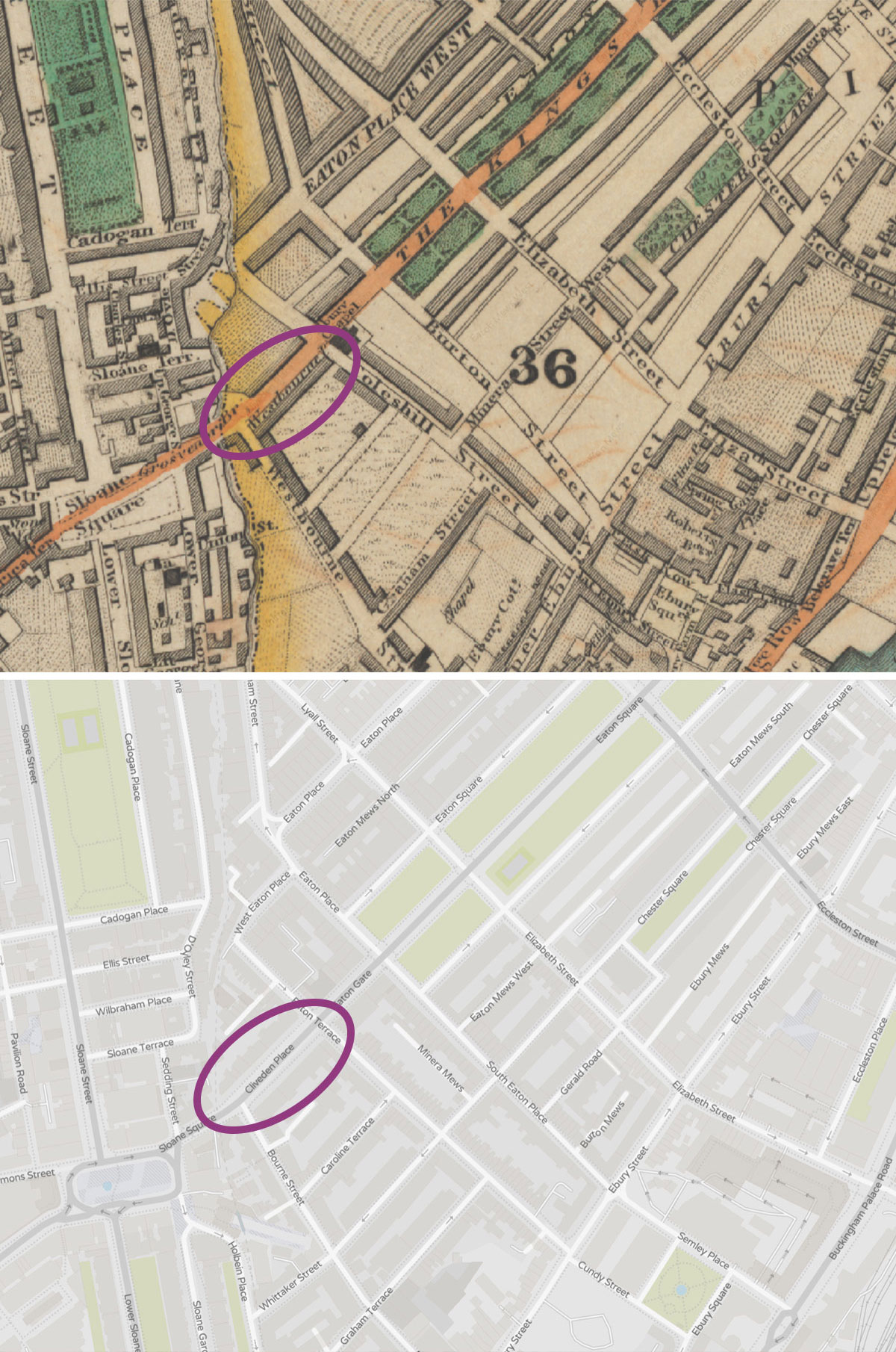
Top: Westbourne Place (circled) on the C and J Greenwood map of 1828; and bottom: the same street, now called Cliveden Place (circled), on a contemporary map. Images courtesy of Layers of London.
But what might the census data reveal anyway?
There were 213 people living in 46 ‘households’ across 34 buildings (one of which was a pub called the Royal Clarence) on Westbourne Place on the day of the 1881 census. If we exclude the pub, of the 207 domestic residents, 67, or 32%, were employed as some kind of servant or maid. This rises to 46% of residents if we exclude those who were listed as having no occupation.
If we widen our search to a 10mile radius from Westbourne Place (further than anyone might walk, or even probably travel by horse-drawn bus, in a day, but a distance possible to travel by underground railway), we find 33 single women with the surname Pearson who were marked as a visitor at the house they were in when the census enumerator knocked on the door. Of those Miss Pearsons, 8, or 24%, are listed as service workers. This rises to 30% if we exclude children under 15 (I reason they’re a bit too young to be independently contributing to the diary project), and 40% if we also exclude those listed as having no occupation.
Even if we rely on the highest possible percentage, is 40-46% enough of a probability to conclude that the Miss Pearson who lived on Westbourne Place and contributed to the OED in the late 19th Century was a servant?
Herein lies one of the challenges of historical research: what’s a historian to do when the leads are not definitive enough, or not there at all? With only a surname and an address, the best possible source to explore is the census – which in turn can reveal a first name, birth date, birthplace, and occupation – but for me and Miss Pearson, it couldn’t help this time. And without any more clues, where am I to turn? Electoral registers can’t help when researching a woman in this period; there’s no mention of a Pearson linked to Westbourne Place in any digitised newspapers during the years she’s known to have lived there; neither is there any trace of her in the documents available to search on Find My Past, such as street and trade directories.
And so, I must accept that this story – for today, at least – ends with unresolved questions rather than a conclusion.

Sources:
- 1881 England, Wales & Scotland Census, dataset: Westbourne Place, City of Westminster, Knightsbridge ward, PRO reference RG 11/100 (via findmypast.co.uk).
- Phil Gyford, ed, The Diary of Samuel Pepys, daily entries from the 17th century London diary (pepysdiary.com).
- ‘History of the OED’, Oxford English Dictionary (OED.com).
- James AH Murray, The address book of readers (REF: OED/B/4/3/3), Oxford University Press Archives; ‘Thirteenth Address Of The President, To The Philological Society, Delivered At The Anniversary Meeting, Friday 16th Mary, 1884’, Transactions of the Philological Society, Volume 19, Issue 1 (1884); A new English dictionary on historical principles: founded mainly on the materials collected by the Philological Society, Volume 1 (1888) .
- Sarah Ogilvie, The Dictionary People: The unsung heroes who created the Oxford English Dictionary (2023); ‘The Dictionary City: Londoners and the Oxford English Dictionary’, Gresham College (2026).
- Oxford English dictionary, Oxford University Press.