John Leland (c.1503-1552) was variously a poet, a tutor, a rector, a royal chaplain, and is described as Britain’s first antiquarian. Indeed, after receiving a commission from Henry VIII (on which more shortly), he referred to himself as the ‘king’s antiquary’.
It was while studying in Paris in the late 1520s that a professor introduced Leland to the manuscripts of poets from centuries past. It sparked in him a love of ancient texts – and the historical knowledge they held – that would influence the rest of his life and career.
By the beginning of the 1530s Leland had returned to England and set out on a mission to catalogue works by English authors in libraries across the country. At this time, monasteries were among the greatest repositories of knowledge – they housed the country’s largest collections of books and were unique in preserving historical texts, including works which dated to before the Norman Conquest and those written in the “no longer comprehensible to anyone” Old English. To quote Nigel Ramsay: “It was in the monastic libraries, and the monastic libraries alone, that British history could be rediscovered”.
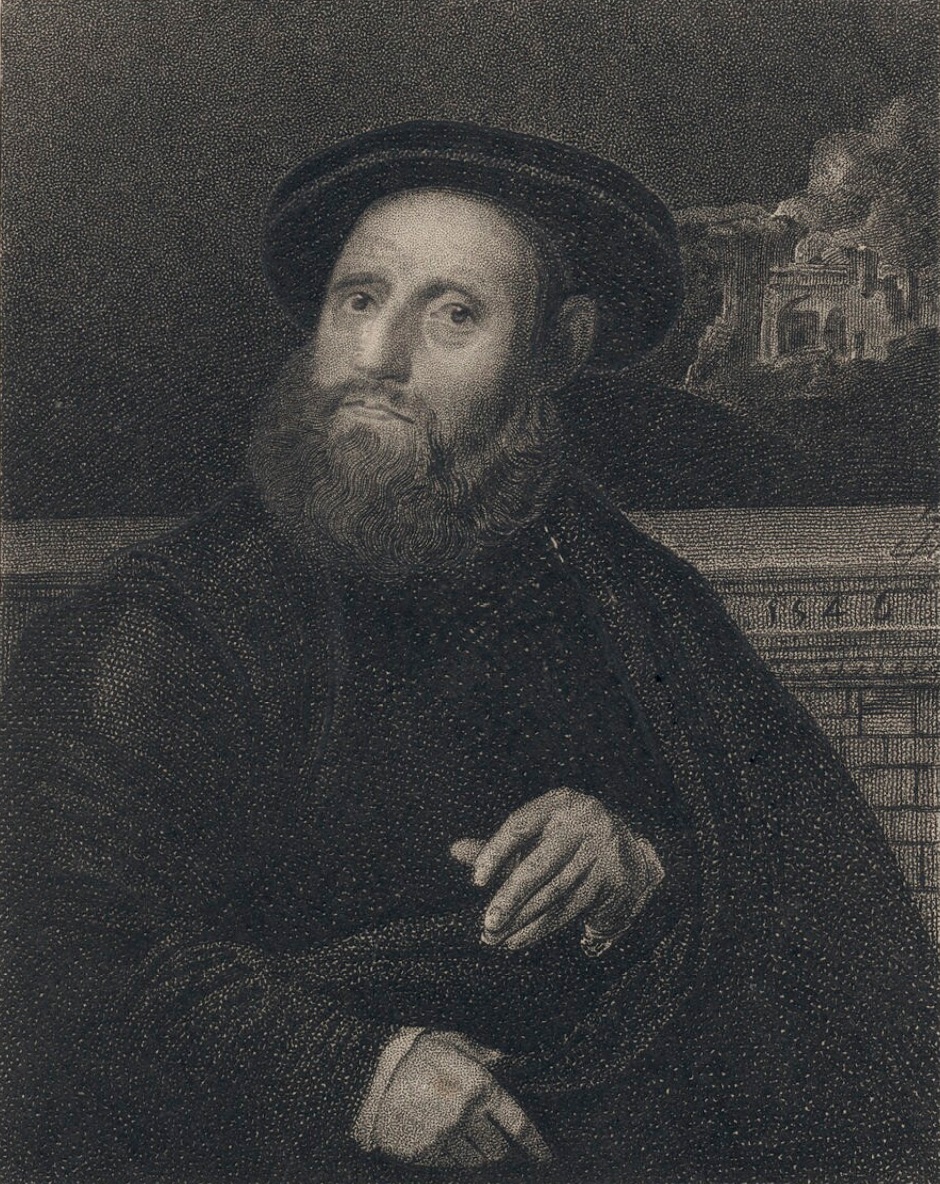
John Leland, engraving by Thomas Charles Wageman, after Hans Holbein the Younger, published 1824. Image © National Portrait Gallery, London (CC BY-NC-ND 3.0).
Leland’s efforts were given greater credibility, when, in 1533 – as James P. Carley explains in a biography of the antiquary – he “received some sort of commission from the King, of which no record survives, ‘to peruse and dylygentlye to searche all the lybraryes of monasteryes and collegies of thys your noble realme’.” This commission, this endorsement, guaranteed Leland access to the best and most bountiful libraries across the country. He surveyed, and sometimes transcribed, the works they held, collecting notes for a planned bibliographical dictionary of English writers “begynning at the Druides” through to his present day.
But a threat to Leland’s mission was fast approaching – the English Reformation. In retaliation for being denied permission by the Pope to divorce his first wife, Catherine of Aragon, and marry his mistress, Anne Boleyn, Henry VIII broke with the Catholic church and papal authority. In 1534 he established the Church of England with him as its Supreme Head. Next came the Dissolution of the Monasteries. Between 1536 and 1540, Henry VIII ordered the closure of more than 800 Catholic places of worship and in some cases the destruction of the buildings themselves. As the 12,000 monks, nuns, and friars were dispersed, so too were the contents of their former homes, including their great libraries.
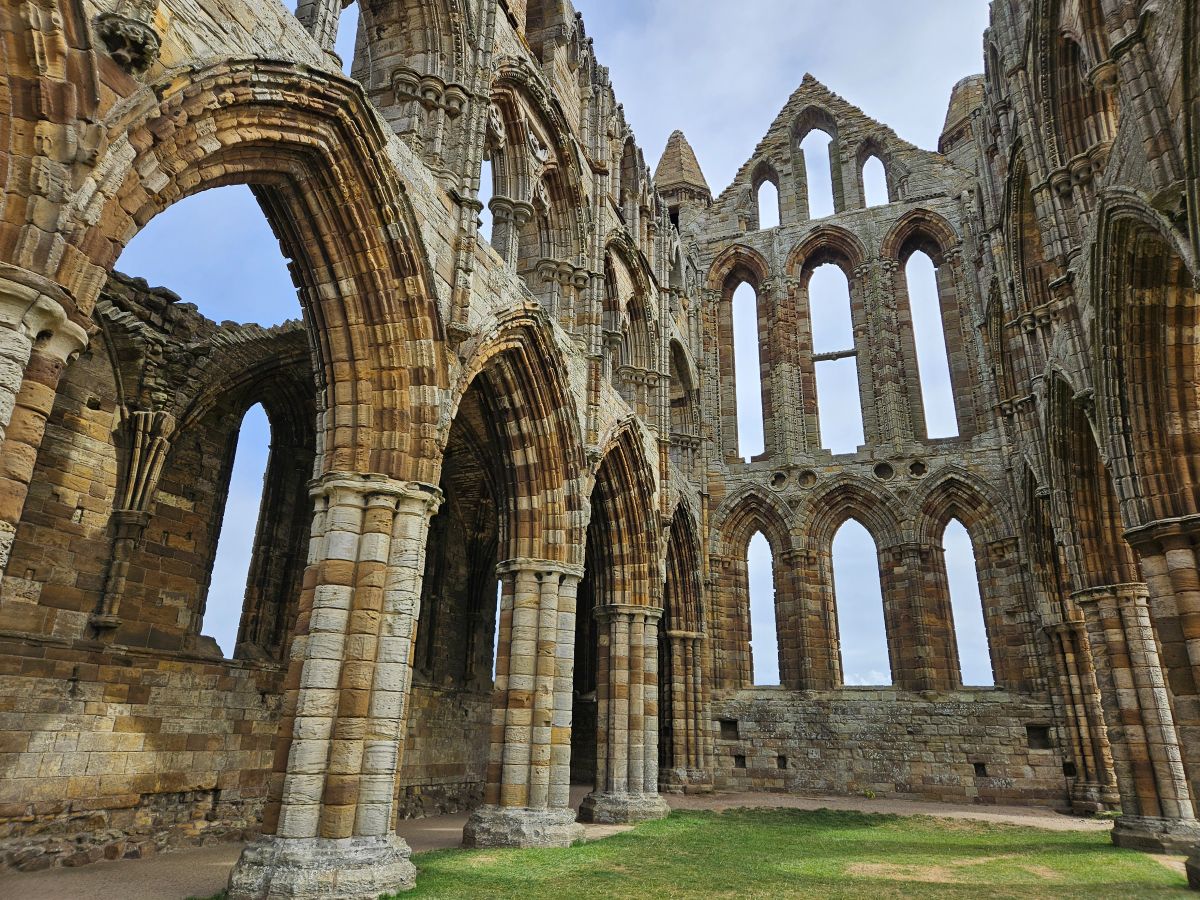
The ruins of Whitby Abbey in Yorkshire, northern England, which was dissolved in 1539 and sold off by Henry VIII.
At least worst, the Dissolution would see the collections of historical texts broken up and scattered with the departing Catholics. The greater fear was that they would be stolen, sold for scrap paper value, or deliberately destroyed. As Alan Coates has written, all these things did happen, as well as “in many cases, books were simply left to await removal by interested parties, or, if not, to disintegrate”.
We can assume that Leland was appalled by all eventualities along that spectrum. This is evidenced by a letter (now sadly lost) he wrote to Thomas Cromwell in 1536 requesting assistance in preserving the precious books: “whereas now the Germanes perceiving our desidiousness and negligence, do send dayly young Scholars hither, that spoileth them, and cutteth them out of Libraries, returning home and putting them abroad as Monuments of their own Country”.
Leland appealed to Henry VIII’s ego, pointing out the threat to the reputation of his realm, its cultural heritage, and the prestige of English scholarship – particularly at the hands of its European neighbours – if the rare and ancient texts of the monastic libraries were not preserved. It was a reputation that had already taken a hit on the continent because of the Reformation.
The ‘king’s antiquary’ found a common thread between his love of history and historical texts, and the urgent need to save them, and his loyalty to, and the national interests of, the monarch at whose direction that very history was being put at risk.
And so, Leland’s mission and tour around the country’s libraries turned from one of surveying to one of saving. In a letter to Henry VIII written in the mid-1540s – known as the ‘new year’s gift’ – he described how he had “conservid many good autors, the which other wise had beene like to have perischid […] of the whiche parte remayne yn the moste magnificent libraries of yowr royal Palacis”. He also said that “Parte also remayne yn my custodye”. Leland’s plan was to use the books to write an account of “your moste noble reaulme, and to publische the Majeste and the excellent actes of yowr progenitors […] that al the worlde shaul evidently perceyve that no particular region may justely be more extollid then yours for trewe nobilite and vertues”.
In fact, none of Leland’s grand plans for publications – not his dictionary of writers, nor his planned topography of England based on his travel diaries, nor a genealogical work of noble families dating back to Saxon origins – were realised in his lifetime. And historians have debated how many books he actually saved. Carley says “less than a dozen of the hundreds of monastic books in the Royal Collection can be shown to have arrived there through his agency”.
Leland died in 1552, following several years of mental illness.
His dictionary of British writers, which was largely complete at his death, was published in 1709 as ‘Commentarii de scriptoribus Britannicis’ by Anthony Hall. It was split over four volumes and contained around 600 entries. Caraline Brett describes the details, gleaned from books across 137 monasteries, as “a crucial last-minute glimpse of the contents of the libraries just before they were permanently scattered”. The notes for his other projects were also published in the following few years. Carley says they remain “valued particularly for the unique insight they provide into Tudor England, and for their witness to the final phase of English monasticism. They continue to be regularly cited”.
And that is John Leland’s legacy. Not the ancient texts he loved and fought to save, but the notes he took along the way, and the resource they’ve provided to antiquarians and historians from the 16th Century onwards, right up to the present day.

Sources:
- Brett, Caraline, ‘John Leland and the Anglo-Norman Historian’, in Anglo-Norman Studies XI: Proceedings of the Battle Conference 1988, (1989)
- Carley, James P., ‘Leland, John (c. 1503–1552), Poet and Antiquary’, Oxford Dictionary of National Biography (2006)
- Coates, Alan, ‘The Dispersal of the Books at the Dissolution’, in English Medieval Books: The Reading Abbey Collections from Foundation to Dispersal (1999)
- Dykes, Christopher Henry, ‘From Deadly Darkness to Vainglorious Light: John Leland’s Antiquarian Projects in Tudor England’ (unpublished thesis, Liberty University, 2025)
- ‘John Leland: Biography; Letter to Henry VIII; Itinerary in North Lancashire and Cumbria’, Lancaster University.
- Lyon, Harriet, Memory and the Dissolution of the Monasteries in Early Modern England, Cambridge Studies in Early Modern British History (2021)
- Ramsay, Nigel, ‘“The Manuscripts Flew about like Butterflies”: The Break-Up of English Libraries in the Sixteenth Century’, in Lost Libraries: The Destruction of Great Book Collections Since Antiquity (2004)